Concrete Driveway Installation

Concrete driveway installation involves preparing the ground, planning drainage, setting out the driveway, placing concrete, applying a suitable finish and allowing it to cure. The right approach depends on the property, ground conditions and vehicles that will use the surface.

For Perth homeowners, business owners and strata managers, planning starts with everyday use. A driveway should provide practical access, suit the building and fit the available space. Its appearance matters, but so do parking arrangements, water flow and access during construction.

This guide explains the main decisions before you request a quote, from choosing a finish to planning the handover.

What Does Concrete Driveway Installation Involve?

A new driveway is a construction project with several connected stages. Before discussing colours, ask what needs to happen beneath the finished surface and around its edges.

A useful project brief records:

  • The area to be installed or replaced.
  • The vehicles expected to use it.
  • Connections to garages, gates and paths.
  • Existing drainage and proposed changes.
  • The preferred finish and budget.
  • Access restrictions during the work.

Keep this brief when comparing contractors. Two quotes for the same driveway area may describe different work, so price alone does not explain the difference.

Planning a Driveway for Your Property

Home Driveways

Think about how your household parks and moves around the property. Can passengers open doors comfortably? Is there a clear walking route to the entrance? Will a gate open without blocking a parked vehicle?

Tell the contractor about caravans, trailers and larger vehicles before the driveway is designed. Also discuss future changes, such as a new garage or wider access. These details belong in the initial brief.

Commercial and Strata Driveways

For a business or shared property, list regular users and delivery vehicles. Ask how residents, customers and staff will enter while work takes place.

Strata managers should confirm who can approve the project and agree on communication before setting dates. A written access plan can identify temporary parking, delivery arrangements and pedestrian routes. Where shared access is restricted, discuss whether staged work is practical for the site.

Choosing a Concrete Driveway Finish

Compare samples alongside the building, boundary walls and landscaping. Ask to see the proposed colour and texture together, rather than choosing from a colour name alone.

Finish Appearance What to discuss
Plain concrete A simple grey surface The proposed texture, edging and joint layout
Coloured concrete Colour selected to suit the property Sample variation, colour method and future care
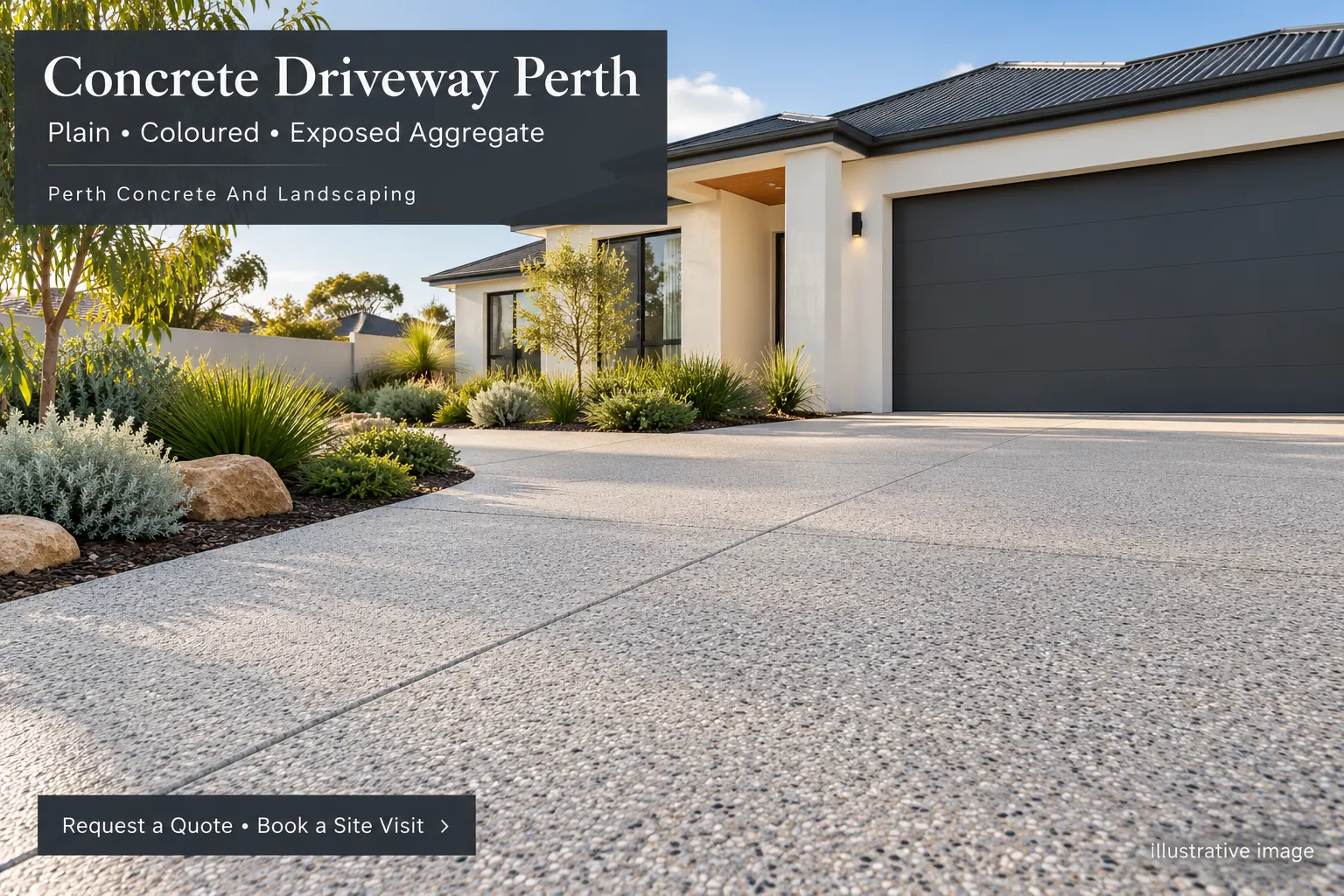
Exposed aggregate Visible stone creates a textured appearance Stone size, colour blend, texture and sealer choice

A finish must suit the driveway slope and wet conditions. CCAA’s Residential Concrete Driveways and Paths guide explains that surface texture and sealers can affect slip and skid resistance. A decorative finish still needs to be assessed for its intended use.

Before choosing, ask: “How will this finish perform on this particular driveway?” This keeps the discussion tied to your property.

How a Concrete Driveway Is Installed

Site Assessment and Ground Preparation

The initial assessment should establish the driveway boundaries, levels and access for equipment. Point out known underground services, irrigation lines and any areas where water collects.

For a replacement, clarify whether the price includes breaking up the old driveway, removing waste and preparing the exposed ground. Ask how unexpected ground conditions will be handled and priced before work begins.

Photograph nearby paving, walls and garden edges before construction. These photos create a useful record and help both parties agree on the work area.

Drainage, Formwork and Reinforcement

Drainage needs attention before concrete placement. The Australian Government’s YourHome stormwater guidance recommends managing runoff from hard surfaces through suitable grading and site measures, including planted areas and infiltration systems where appropriate.

Ask where driveway water will go and whether existing drainage needs changes. The proposal should suit the property and local requirements.

Formwork establishes the edges and shape of the pour. Before placement, ask the contractor to confirm the agreed width, levels and connections. Concrete thickness, strength and reinforcement should be specified for the expected use, rather than selected from appearance alone.

Concrete Placement, Finishing and Joints

Concrete is placed within the prepared area and finished to the agreed surface. Confirm the finish, borders and planned joint positions before pouring starts.

Joints help accommodate movement or manage where shrinkage cracks form. They do not guarantee that concrete will remain crack-free. Ask the contractor to explain the layout, especially near corners, existing structures and changes in driveway shape.

Curing and Protection

Curing helps concrete develop strength by controlling moisture loss after finishing. Adbri Cement’s technical FAQs explain that poor curing can reduce strength and durability and increase the chance of cracking.

Ask which curing method will be used and who will protect the driveway during this period. Follow the contractor’s instructions rather than adding your own treatments.

Weather also affects the work. CCAA’s Hot Weather Concreting datasheet identifies faster moisture loss and faster cement reactions as concerns in hot conditions. Discuss how weather could change the pour date or protection arrangements.

Do You Need Approval for a Driveway in Perth?

Separate the driveway inside your boundary from the crossover connecting it to the road. Work on the crossover may need council approval even when it forms part of a larger driveway project.

For example, the City of Perth requires crossover approval before work starts. That requirement applies within its council area; other Perth councils have their own procedures and specifications.

Before booking construction, confirm with your council:

  • Whether the proposed work needs approval.
  • Which drawings or measurements are required.
  • Whether width, levels or materials are restricted.
  • Whether trees, footpaths or other verge features affect the proposal.

Record who will submit any application and whether application costs are included in the quote.

What Affects Concrete Driveway Installation Costs?

There is no single price that describes every Perth driveway. A clear estimate should relate to the actual site and agreed work.

Ask the contractor to explain these cost items:

  • Area and shape: The measured driveway and any additional sections.
  • Existing surface removal: Demolition, loading and disposal.
  • Ground preparation: Excavation and any necessary base work.
  • Access: Space for equipment and concrete delivery.
  • Drainage: New drains or changes to existing arrangements.
  • Finish: Colour, aggregate selection and decorative details.
  • Vehicle use: Any design requirements for heavier traffic.
  • Handover work: Clean-up, sealing if specified and repairs to disturbed areas.

Compare quotes against the same written brief. Check whether GST, exclusions and possible additional charges are clearly stated. Ask for a written process for approving changes so that extra work is discussed before it proceeds.

How Long Does Installation Take?

The schedule includes more than the pour. It may involve approvals, removal, preparation, drainage work, concrete placement, curing and any later surface treatment.

Ask for separate dates or milestones for:

  1. Site preparation and removal.
  2. Concrete placement.
  3. Pedestrian access.
  4. Passenger vehicle access.
  5. Any heavier vehicle access.

A surface that looks firm is not automatically ready for traffic. The responsible contractor should confirm when each type of use can resume, taking account of the concrete and site conditions.

Arrange alternative parking before the start date. Commercial and strata managers should share access instructions with occupants and delivery contacts, then update them if the schedule changes.

Caring for Your New Concrete Driveway

Request written care instructions at handover, including advice for the selected finish and any sealer.

Keep leaves and loose dirt from building up. Attend to spills using cleaning products suitable for the surface, and check with the contractor before using strong chemicals or pressure cleaning.

Keep drainage openings clear and watch how water behaves after rain. Report unexpected pooling, movement or surface damage with photographs so the contractor can assess it.

If sealing forms part of the project, record the product and application date. Follow its maintenance guidance rather than assuming every driveway needs the same resealing schedule.

Arrange a Free Site Visit and Free Quote in Perth

Planning concrete driveway installation for a home, commercial building or strata property? Perth Concrete And Landscaping offers a free site visit and free quote to help you discuss the project.

Prepare your approximate driveway measurements, preferred finish and vehicle requirements before the visit. Include any access concerns or drainage questions so these can be discussed together.

Contact Perth Concrete And Landscaping to arrange your free site visit and request a free quote for concrete driveway installation in Perth.

Frequently Asked Questions

1. How thick should a concrete driveway be?

Thickness depends on vehicle loads and site requirements. CCAA’s residential guide gives 100 mm as a minimum for vehicles below three tonnes gross mass, with thicker pavement for heavier use. This is general guidance, not a specification for every driveway. Have your project requirements confirmed. Source: CCAA driveway guide.

2. When can I drive on a newly installed concrete driveway?

Follow the contractor’s stated vehicle-access date. Curing supports strength development, and the initial curing period is not itself permission to drive on the surface. Ask for separate instructions for passenger cars and heavier vehicles. Source: Adbri Cement curing guidance.

3. Do I need council approval for a concrete driveway in Perth?

Check with the council responsible for your address, especially for a new or altered crossover. The City of Perth, for example, requires approval before crossover construction. Do not assume one council’s rules apply throughout metropolitan Perth. Source: City of Perth crossover applications.

4. Can a concrete driveway develop cracks?

Yes. Concrete can crack as it shrinks or moves. Planned joints, suitable construction and curing help manage the risk, but do not remove it entirely. Ask the contractor to assess cracks that widen, create uneven levels or affect use. Source: CCAA driveway guide.

5. Which concrete finish suits a driveway?

Choose a finish for the slope, vehicle use, wet conditions and appearance you want. Plain, coloured and exposed aggregate options should be assessed together with their texture and any sealer. There is no single finish suited to every site. Source: CCAA driveway guide.
Affordable Concrete Driveway Contractors Perth

A new concrete driveway should suit your property, daily use, and budget. For anyone comparing affordable concrete driveway contractors in Perth, the best starting point is a clear scope of work. You need to know what the price covers before deciding whether it offers good value.

You can manage costs through a practical layout, a suitable finish, and early planning. The ground preparation and construction details still need to suit the site and the vehicles using it.

Perth Concrete And Landscaping offers free quotes and free site visits for customers planning driveway projects. This guide explains what to compare, where savings may be possible, and which questions to ask before booking.

What Makes a Concrete Driveway Affordable?

An affordable driveway fits your budget while meeting the needs of the property. Compare the full installed cost, rather than a headline square-metre rate alone.

A quote that leaves out demolition, soil removal, or drainage may appear cheaper until those costs are added. Ask each contractor to price the same area, finish, and scope.

Think about future care as well. Ask whether the chosen finish needs sealing, what cleaning is recommended, and when maintenance may be needed. A finish you can comfortably maintain may be a better fit than one chosen only for appearance.

What Affects Your Concrete Driveway Quote in Perth?

A site visit helps identify the work needed before concrete can be placed. Discuss these details:

  • Driveway area: Confirm the measurements and boundaries of the work.
  • Removal: Identify any old concrete, paving, roots, or other material to be removed.
  • Ground preparation: Ask how the ground will be assessed and prepared.
  • Access: Check whether trucks and equipment can reach the work area.
  • Drainage and levels: Agree how water will be managed and how the driveway meets existing surfaces.
  • Finish: Request separate prices for plain, coloured, and exposed aggregate options.
  • Vehicle use: Explain whether the driveway will carry cars, delivery vehicles, or heavier loads.
  • Crossover work: Confirm whether the section across the verge is included.

As one local pricing reference, CJH Concrete publishes approximate rates of $70–$90 per square metre for plain concrete and $100–$150 for exposed aggregate. These are that provider’s guide prices, checked in October 2026—not Perth Concrete And Landscaping rates or a fixed Perth-wide price. Removal, access, and site conditions can change the total.

Use published prices to prepare questions. Use a written quote based on your property to set the project budget.

Plain, Coloured or Exposed Aggregate Concrete?

The finish is one part of the budget you can discuss without changing the driveway’s intended use. Request prices based on the same layout and construction requirements.

Option Appearance Budget discussion Care questions
Plain concrete Simple grey finish Ask for this as the baseline quote Confirm cleaning and any sealing advice
Coloured concrete Colour selected to suit the property Ask for the added cost of the chosen colour and treatment Check colour care and coating requirements
Exposed aggregate Visible stone texture Ask how the stone blend and finishing affect the price Confirm cleaning and resealing advice

Plain Concrete Driveways

Plain concrete is worth pricing first when your main goal is a practical driveway within a set budget. A simple finish can suit homes, rental properties, and shared access areas.

Discuss the surface texture, edges, and joint layout. Plain concrete still needs a construction plan suited to the site.

Coloured Concrete Driveways

Coloured concrete gives you more control over the appearance. Ask how the colour is applied and view a sample before confirming your choice.

Keep the layout simple if you want to direct more of your budget toward colour. Confirm whether coatings or sealing are included in the quote.

Exposed Aggregate Concrete Driveways

Exposed aggregate creates a surface with visible stones. Review samples to compare the stone size, blend, and overall appearance.

If the preferred blend exceeds your budget, ask whether another blend or a simpler layout changes the cost. Confirm that the proposed finish suits the driveway’s slope and use.

How to Save Money Without Cutting Construction Quality

Keep the Layout Practical

Start with the space needed for parking, turning, and access. Ask whether unnecessary curves, borders, or decorative sections can be removed from the design.

Do not reduce the driveway so far that vehicles cannot use it comfortably. A saving should leave you with a workable layout.

Compare Complete Written Quotes

Give every contractor the same brief. Include the approximate area, preferred finish, current surface, and expected vehicle use.

Then check whether each quote includes:

  • Removal and disposal of existing material.
  • Excavation and ground preparation.
  • Proposed concrete thickness and strength.
  • Reinforcement and joint details where required by the design.
  • Drainage work and connections within the agreed scope.
  • Surface finishing and any sealing.
  • Cleanup, GST, exclusions, and payment terms.

If an item is missing, ask for clarification before comparing totals. Confirm how changes or unexpected site work will be priced.

Retain the Work Your Driveway Needs

Ask the contractor to explain the preparation, concrete specification, joints, and curing plan. Do not request a thinner slab or remove specified work simply to lower the price.

Cement Australia’s curing guidance explains that moisture supports strength development and surface hardness. It also advises starting protection as soon as finishing is complete. Ask for a curing method suited to your driveway finish and site conditions.

Agree on the finish and layout before work begins. Late changes can require a revised scope, so confirm their cost in writing.

Planning Residential, Commercial and Strata Driveways

For a residential driveway, discuss parking needs, garage access, and any trailers or heavier vehicles you use.

For a commercial driveway, explain delivery vehicle loads, turning movements, and operating hours. Ask how the proposed work will accommodate those needs.

For a strata property, confirm who can approve the work and agree on access arrangements for residents. Share the proposed schedule and restrictions through the property’s usual management process.

Provide this information before requesting a final quote. It helps the contractor price the actual use of the driveway.

Check Crossover Requirements Before Work Starts

The crossover is the vehicle access section between the road and property boundary. It may have separate council requirements from the driveway inside the property.

For example, the City of Perth requires crossover approval before work begins. Its application asks for a sketch showing dimensions and nearby features such as trees, poles, and pits.

Check with the council responsible for your property. Ask who will arrange any required application and whether related costs are included in the quote.

Questions to Ask Before Choosing a Contractor

Use these questions during your free site visit:

  1. What work is included, and what is excluded?
  2. Which finish suits my budget and intended use?
  3. How will the ground, levels, and drainage be handled?
  4. What concrete specification and joint layout are proposed?
  5. Are crossover requirements part of the scope?
  6. What happens if unexpected site conditions are found?
  7. How will curing and access restrictions be managed?
  8. What maintenance and written aftercare instructions will I receive?

Clear answers make it easier to compare proposals and choose a contractor with a scope you understand.

Request a Free Quote and Book a Free Site Visit

Perth Concrete And Landscaping offers free quotes and free site visits. Discuss your budget, property access, and preferred plain, coloured, or exposed aggregate finish before deciding on the scope.

If you are comparing affordable concrete driveway contractors in Perth, start with a plan for your own property. Request a free quote or book a free site visit with Perth Concrete And Landscaping to discuss the work and available options.

Frequently Asked Questions

1. How much does a concrete driveway cost in Perth?

The total depends on the area, finish, removal work, access, and site conditions. One local provider publishes guide rates of about $70–$90/m² for plain concrete and $100–$150/m² for exposed aggregate. Treat these as that provider’s estimates, not a fixed price for your project. Source: CJH Concrete driveway guide.

2. Is plain concrete cheaper than coloured or exposed aggregate concrete?

Plain concrete is a useful baseline to request. The local guide cited here lists plain concrete below exposed aggregate, but it does not establish a price for every coloured finish. Ask for all three options on the same scope. Source: CJH Concrete driveway pricing.

3. How can I reduce driveway costs without cutting quality?

Discuss a simpler layout and finish, then compare complete quotes. Keep the specified construction and curing work. Curing supports strength development and surface hardness, so shortening that process is not a sound budget measure. Source: Cement Australia curing guidance.

4. Do I need council approval for a driveway crossover?

Check with your local council before work starts. The City of Perth requires approval for crossover construction, but properties elsewhere in the metropolitan area fall under their own council’s requirements. Source: City of Perth crossover application.

5. When can vehicles use a newly installed concrete driveway?

Follow the contractor’s written instructions for your project. Concrete mix, thickness, weather, curing conditions, and vehicle weight affect the timing. Do not assume the driveway is ready for traffic because the surface looks dry. Source: Maitland Ready Mixed Concrete traffic guidance.

Concrete Driveway Perth

A concrete driveway in Perth should suit your vehicles, property layout and budget. Before choosing a finish, check the ground conditions, drainage, access and any council requirements for the crossover. Plain, coloured and exposed aggregate concrete offer different looks, but each needs careful planning and construction.

For homeowners, business owners and strata managers, a driveway is part of everyday access. It needs to connect with the property and provide enough room for the vehicles using it.

Perth Concrete And Landscaping works on driveways and other outdoor concrete projects. This guide will help you compare options and prepare for a useful site visit.

Choosing a Concrete Driveway for Your Perth Property

Start with how the driveway will be used. Tell your contractor about the vehicles, parking needs and any access problems with the current layout.

Residential Driveways

For a home, think about garage access, visitor parking and space to open car doors. Check whether the layout allows you to move bins, reach the front entry and walk past parked vehicles.

If you are replacing an old surface, explain what you want to improve. This might be an awkward turn, a narrow entrance or water collecting near the garage.

Bring photos and rough measurements to your first discussion. They help explain the project, although final measurements should be checked on site.

Commercial and Strata Driveways

Shared access needs extra planning. Discuss delivery vehicles, visitor parking and how residents or staff will enter the property during the work.

A driveway serving passenger cars may need a different design from one regularly used by heavier vehicles. Confirm the expected traffic before the slab is designed.

For strata sites, ask the strata manager to confirm who can approve the work and whether the driveway forms part of common property. Agree on access arrangements before setting construction dates.

Plain, Coloured or Exposed Aggregate Concrete?

The finish affects the appearance and surface feel of your driveway. CCAA’s driveway and paving guide describes a range of concrete colouring and finishing options.

Finish Appearance What to discuss before choosing
Plain concrete Simple grey surface Surface texture, edges and overall layout
Coloured concrete Colour chosen to suit the property Physical samples, colour method and care advice
Exposed aggregate Visible stones in the surface Stone blend, texture, sealing and cleaning

Plain Concrete Driveways

Plain concrete offers a simple look that can suit many property styles. If you want a straightforward surface, ask for a quote using a practical outdoor finish.

Plain describes the colour choice; it does not mean the surface must be smooth. Discuss the texture needed for your driveway’s slope and use.

Coloured Concrete Driveways

Coloured concrete can help connect the driveway with the house, boundary walls and landscaping. Compare samples beside existing materials before choosing.

Ask how the colour will be applied and whether a sealer is included. Also ask what natural variation to expect. A website photo is useful for ideas, but a physical sample gives you a better basis for discussion.

Exposed Aggregate Driveways

Exposed aggregate reveals stones at the surface. The stone blend and concrete colour together shape the finished look.

Compare the texture as well as the colour. If people will walk across the driveway to reach the front door, include that route in the discussion. Ask how the selected finish and sealer suit the slope and wet conditions.

What Affects Concrete Driveway Costs in Perth?

An accurate price needs a clear scope and a site check. A square-metre rate alone may leave out work your property requires.

When requesting quotes, ask each contractor to price the same items:

  • The measured driveway area and selected finish.
  • Removal and disposal of the existing surface.
  • Excavation and ground preparation.
  • Site access and any pumping requirements.
  • Drainage work and connections.
  • The concrete design for the expected vehicles.
  • Crossover work, if included.
  • Sealing, cleanup and applicable taxes.

Ask what could change the price after work starts and how additional work would be approved. A written quote makes it easier to compare the full job.

Site Preparation, Drainage and Concrete Quality

Appearance is only one part of the project. The ground, slab design and construction details also need attention.

Ground Preparation and Vehicle Loads

Ask how the contractor will assess and prepare the ground. Explain whether the driveway will carry cars, caravans, work vehicles or deliveries.

CCAA’s Residential Concrete Driveways and Paths guide explains that vehicle loads affect pavement design and that heavier applications may need engineering input. There is no single slab specification suited to every property.

Drainage and Driveway Levels

Have the contractor check how the driveway meets the garage, footpath and nearby structures. Water runoff should be planned before pouring.

The same CCAA guide discusses drainage falls and the need for suitable drainage where a driveway slopes towards a building. Ask where runoff will go and whether a drain is part of the quote.

Joints and Curing

Joints help manage concrete movement and where shrinkage cracks develop. They do not guarantee a crack-free driveway.

Curing is the care given to fresh concrete to help it develop its properties. CCAA provides a separate curing guide.

Before work begins, ask how curing will be managed and when the surface can take foot traffic, cars and heavier vehicles. Get those instructions in writing.

Do You Need Council Approval for a Driveway in Perth?

The driveway within your property and the crossover across the verge are different parts of the access route.

For example, the City of Stirling requires prior approval for crossover works. This should not be treated as one rule for every Perth council.

Contact the council responsible for your address before constructing or changing the crossover. Ask about the application, permitted dimensions, materials, levels and any nearby trees or services.

Confirm who will handle the application and whether the quote includes the crossover.

Questions to Ask Before Accepting a Driveway Quote

Use this checklist during your site visit:

  • Does the quote cover the whole access area?
  • Which finish and sample have we agreed on?
  • What preparation and removal work is included?
  • How will drainage be handled?
  • Is the design suitable for our vehicles?
  • Who checks council and property approvals?
  • How will access be managed during construction?
  • What curing and maintenance instructions will we receive?

Keep the accepted scope, samples and written instructions together for reference.

Planning Your Driveway with Perth Concrete And Landscaping

A site visit is a useful time to discuss the layout, compare finishes and identify work that needs to be included in the quote.

Perth Concrete And Landscaping’s business information lists driveways among its outdoor concrete projects. Share your property location, rough dimensions, photos and preferred finish when making an enquiry.

Whether you prefer plain, coloured or exposed aggregate concrete, start with the needs of your property. For your concrete driveway Perth project, contact Perth Concrete And Landscaping to request a quote or book a site visit.

Frequently Asked Questions

1. Which concrete driveway finish should I choose?

Choose based on appearance, slope, surface texture and upkeep. Compare physical samples and discuss wet-weather use. CCAA’s driveway and paving guide explains the available design flexibility.

2. How much does a concrete driveway in Perth cost?

The price depends on the scope, including size, finish, removal, preparation, access and drainage. Request an itemised site-based quote. CCAA’s residential driveway guide identifies planning and construction details that can change the work required; it does not provide current Perth prices.

3. Do I need approval for driveway crossover work?

Check with your council before work starts. The City of Stirling, for example, requires prior approval for crossover works. Your own council must confirm the requirements for your address.

4. When can I drive on newly poured concrete?

Follow the written instructions for your project. The mix, curing conditions and vehicle loads affect the handover advice. CCAA’s curing guidance explains why fresh concrete needs proper care.

5. How should I maintain my concrete driveway?

Remove dirt and deal with spills using a cleaning method suited to the finish. Follow any sealer care instructions. CCAA’s Cleaning Concrete guide provides guidance on cleaning methods and products.

Concrete Driveways Perth

A driveway should make arriving home, parking and moving around your property easier. Its appearance matters, but the layout and construction need to suit the vehicles that will use it.

When planning concrete driveways Perth homeowners can start with three questions: what needs to fit, where will water go, and what work does the site need? Answering these before choosing a colour helps you compare quotes with confidence.

Perth Concrete And Landscaping welcomes enquiries about new and replacement driveways. This guide explains what to discuss before booking your project.

What Makes a Driveway Suitable for Your Property?

A suitable driveway matches your vehicle use, available space and access needs. Tell your contractor about cars, trailers, caravans or occasional delivery vehicles that may use the area.

Think beyond the number of parked vehicles. Check whether people can open car doors, walk to the front entrance and move bins without squeezing between obstacles.

Plan for Everyday Parking

Sketch where each vehicle normally sits. Include the garage entrance, gates, garden beds and any areas you want to keep clear. If you are planning a future vehicle purchase, mention it during the site discussion.

For shared properties, ask who must approve the work and how residents will reach their homes during construction. Builders should provide current plans and explain when other trades need access.

Site Access, Levels and Drainage

A driveway joins several parts of a property. The contractor needs to understand the road connection, garage level and neighbouring surfaces.

The CCAA residential driveways and paths guide discusses drainage and vehicle clearance at changes in slope. It also notes that work between the property boundary and kerb must meet the relevant local authority’s requirements.

Ask your contractor to explain:

How existing material will be removed.

Where equipment and deliveries will enter.

How the driveway will meet the garage and crossover.

Where rainwater will drain.

Whether local authority checks are needed.

Do not assume that replacing an existing driveway means its old levels should be copied. Point out places where water collects or your vehicle scrapes.

Choosing a Driveway Finish

View samples before making your selection. Plain concrete, exposed aggregate and other finishes offer different appearances and textures.

Your concern What to discuss
Street appearance How the finish works with brick, render and landscaping
Sloping access Suitability of the proposed texture for the slope
Vehicle use Design for the expected vehicles
Cleaning How spills and dirt will be managed
Future upkeep Any sealing and maintenance requirements


Ask to see the proposed finish in similar conditions. A small indoor sample may look different from a large outdoor surface.

What Should Your Driveway Quote Include?

Request an itemised scope rather than a price per square metre alone. Confirm the measured area, removal work, preparation, proposed concrete specification, reinforcement, joints and finish.

Also ask whether delivery access, pump hire where needed, drainage work and waste removal are included. A replacement project may need different work from a clear new site.

Agree on the contact person and how changes will be approved. Put any requests about retaining garden beds, protecting gates or keeping a walkway open into the written scope.

Curing, Vehicle Access and Ongoing Care

Ask for a handover plan before placement. You will need to arrange parking elsewhere until the contractor confirms the driveway can take your vehicles.

Concrete Society guidance on curing explains why newly placed concrete needs protection from moisture loss. Looking dry is not the same as being ready for vehicle loads.

Request written advice about first use, cleaning and any sealer. Keep the product details so future maintenance suits the finish.

Plan Your Driveway With Perth Concrete And Landscaping

Send photos, approximate dimensions and details of your vehicles to Perth Concrete And Landscaping. Mention any drainage concerns and whether you are replacing an existing surface. For concrete driveways Perth property owners can plan around their own needs, request a quote or book a site visit.

Frequently Asked Questions

1. What affects the cost of a concrete driveway in Perth?

Area, removal, access, preparation, design and finish affect the scope. Request a written quote showing inclusions. WA Consumer Protection explains what quotes should contain.

2. Can I replace an existing driveway?

Discuss removal and reassessment of levels with your contractor. Ask what can be reused and what needs changing. See the planning topics in CCAA’s driveway guide.

3. Which driveway finish should I choose?

Compare appearance, texture and intended use. Ask for samples suitable for your site. ACI’s exterior finish guidance discusses surface appearance and texture.

4. Do I need to check crossover requirements?

Yes. Confirm the rules with your local authority before work on the road connection. CCAA’s guide identifies local authority requirements for this area.

5. When can I drive on new concrete?

Follow written project-specific advice for the intended vehicle loads. Curing guidance explains the need for protection after placement.

Concrete Driveway Contractors in Perth: How to Choose the Right Team

A concrete driveway must carry daily vehicle traffic, handle Perth weather and direct water away from buildings. Its performance depends on far more than the concrete visible at the surface.

Experienced concrete driveway contractors should assess the site, prepare the ground, plan drainage, install formwork and reinforcement, place the concrete, create joints and manage curing.

Perth Concrete and Landscaping provides concrete driveway services for homeowners, builders, developers, property managers and commercial property owners across Perth. An on-site visit helps the team recommend a suitable layout, finish and project scope for each property.

What Do Concrete Driveway Contractors Do?

Concrete driveway contractors manage the full installation process, from measuring the site to completing the final surface. Their work should cover both the appearance of the driveway and the structure supporting it.

On-Site Assessment and Measurements

A contractor should inspect the property before preparing the final quote. The assessment may include:

  • Driveway length, width and total area
  • Number and type of vehicles
  • Existing ground conditions
  • Slope and drainage direction
  • Access for excavation equipment
  • Nearby buildings, walls and gates
  • Trees, footpaths and kerbs
  • Underground and above-ground services
  • Connection to the road or crossover

Accurate measurements also help reduce unexpected changes after work starts.

Excavation and Ground Preparation

A long-lasting driveway needs a firm and stable base. Site preparation may involve removing an old driveway, excavating unsuitable material and installing a compacted sub-base.

The required preparation depends on the soil, previous site use, vehicle loads and driveway design. Concrete placed over loose or poorly prepared ground may be more likely to move or settle.

Formwork, Reinforcement and Concrete Placement

Formwork creates the shape, edges, levels and slope of the driveway. Reinforcement is then positioned according to the project specification.

The concrete must be placed and finished while it remains workable. This part of the project needs suitable planning because weather, site access and delivery timing can affect the pour.

Finishing, Joints and Curing

The chosen surface finish is applied after the concrete is placed. The contractor also installs or cuts joints in planned locations.

Joints help manage movement and guide shrinkage cracks. Reinforcement and joints can control cracking, but no responsible contractor should promise that outdoor concrete will never crack.

Curing helps concrete develop strength and reduces rapid moisture loss. Cement Concrete & Aggregates Australia provides guidance covering concrete driveway planning, construction, curing and maintenance.

Which Concrete Driveway Services Are Available?

The right service depends on whether the property needs a new driveway, replacement or added parking space.

New Concrete Driveway Installation

A new driveway can be installed for:

  • Newly built homes
  • Renovated properties
  • Subdivided blocks
  • Investment properties
  • Commercial premises
  • New parking or access areas

The layout should account for vehicle movement, garage access, gates, pedestrian areas and water runoff.

Old Driveway Removal and Replacement

Replacement may be suitable when an old driveway has widespread cracking, severe settlement, poor drainage or major surface damage.

The existing material normally needs to be broken up and removed before the ground can be assessed. A contractor should explain whether removal, disposal and new base preparation are included in the quote.

Small areas of damage do not always mean the full driveway needs replacement. Ask the contractor whether repair is practical and how the repaired area may look beside the existing concrete.

Driveway Extensions and Widening

A driveway extension can provide more parking or improve vehicle access. Before extending a driveway, check:

  • Property boundaries
  • Council crossover limits
  • Street trees and service pits
  • Drainage paths
  • Footpath connections
  • Access to gates and garages

New concrete placed beside an older slab may not have the same colour. The contractor should explain likely differences before work begins.

Which Concrete Finish Is Right for Your Driveway?

Concrete is available in several finishes. Your choice can affect appearance, texture, cleaning needs and project cost.

Plain Concrete Driveways

Plain concrete offers a simple and practical surface. It is commonly used where function and easy care are the main goals.

A broom finish can add texture to the surface. Ask the contractor to explain the proposed finish and how it will perform on sloped or frequently wet areas.

Coloured Concrete Driveways

Coloured concrete can connect the driveway with the home’s exterior, roof, fencing or landscape design.

Colours may appear different under changing light and weather conditions. The finished result can also vary from a small sample, so ask how the colour will be added and protected.

Exposed Aggregate Driveways

Exposed aggregate reveals selected stones within the concrete surface. It offers a textured appearance and is often chosen for modern homes and feature entrances.

Ask to see completed projects or physical samples. The aggregate blend, exposure method and sealer can change the final appearance.

Decorative Concrete Finishes

Decorative options can include borders, patterns, contrasting sections and custom layouts. These finishes can create a distinctive entrance, but they may need added labour and care.

Finish Appearance Care level Common application Question to ask
Plain concrete Clean and simple Low Homes and utility areas Which surface texture is included?
Coloured concrete Coordinated colour Low to moderate Modern homes How is the colour added?
Exposed aggregate Textured and decorative Moderate Feature driveways Can I view the aggregate sample?
Decorative concrete Custom appearance Varies Entrances and designed spaces What upkeep will the finish need?

What Should Be Checked Before Driveway Work Starts?

Pre-construction checks can prevent delays, layout problems and unexpected costs.

Council Crossover Approval

The crossover is generally the section connecting the property boundary to the road. Approval rules vary between councils.

The City of Perth states that a crossover between the road edge and property must be approved before work begins. Its application also asks for a sketch showing dimensions and nearby trees, poles and pits.

A property elsewhere in metropolitan Perth will fall under a different council. The owner or contractor should check that council’s current rules before starting work.

Underground Services and Site Access

The work area should be checked for service lines, pipes, pits, irrigation and other site features.

Contractors also need safe access for machinery, concrete delivery and waste removal. Restricted access can affect the method, schedule and price.

Driveway Slope and Stormwater

The driveway should be planned so water does not flow toward the house, garage or neighbouring property. The contractor may recommend suitable falls, drains or channels based on the site.

Drainage requirements can differ between councils and properties. Any proposed connection to council drainage must follow the relevant approval process.

Trees, Footpaths, Kerbs and Verges

Street trees and public infrastructure may limit the crossover’s position or width. A new driveway should not be planned on the assumption that a tree, pole, pit or kerb can be moved.

These items should be identified during the site visit and shown on any required application.

Permits, Registration and Insurance

Ask the contractor which permits or approvals apply to the job. Requirements can depend on the type, permit status and value of the work.

WA homeowners can use the Building and Energy licence and registration search to check any registration required for a project.

You should also ask for proof of current public liability insurance and confirm who is responsible for council applications.

Why Site Preparation Matters in Perth

The finished surface may look good on the day of the pour, but the work underneath can affect how the driveway performs over time.

Soil and Existing Ground Conditions

Perth properties can have sandy, filled or disturbed ground. Site conditions may also vary within a single property.

A contractor should inspect the area and explain the excavation and base preparation included in the scope. Deeper excavation or added base material may be needed where the ground is soft or unstable.

Sub-Base Preparation and Compaction

A compacted sub-base creates a stable platform for the driveway. Its material and depth should suit the site and intended vehicle use.

Ask whether the quote includes:

  • Excavation depth
  • Removal of unsuitable material
  • Sub-base material
  • Compaction
  • Final level checks

Drainage Planning

Drainage should be planned before formwork and concrete placement. Once the slab is installed, changing its slope can be difficult and costly.

The contractor should explain where surface water will go and whether drains or channels are needed.

Formwork and Levels

Formwork holds the wet concrete in place and establishes the driveway’s shape. Levels should connect correctly with the garage, paths, gates, kerb and surrounding landscape.

Reinforcement, Concrete Thickness and Joints

Driveway construction details should match the property, ground conditions and expected traffic.

How Is Driveway Thickness Chosen?

There is no single specification for every driveway. Thickness may depend on:

  • Passenger cars or heavier vehicles
  • Soil and sub-base conditions
  • Driveway slope
  • Council crossover specifications
  • Concrete design
  • Engineering or permit requirements

Ask for the proposed slab specification in writing instead of relying on a verbal description.

What Does Reinforcement Do?

Reinforcement helps control crack width and supports the intended slab performance. It must be correctly supported and positioned within the concrete.

Mesh left on the ground may not sit at the intended level within the slab. Ask how the contractor will support the reinforcement during the pour.

Why Are Control and Isolation Joints Used?

Control joints create planned locations for shrinkage movement. Isolation joints separate the driveway from fixed structures such as walls, columns or existing slabs.

Joint type, spacing and position should be planned before the concrete is placed. CCAA guidance explains that concrete pavement joints include movement joints and joints used to control cracking.

Can a Contractor Promise That Concrete Will Never Crack?

No honest contractor can guarantee that outdoor concrete will remain completely free from cracks.

Concrete can shrink as it loses moisture. Temperature changes, soil movement, tree roots and heavy loads may also affect it. Good preparation, reinforcement, joint placement and curing can reduce risk and help manage cracks.

How Long Does a Concrete Driveway Take to Install?

The project period depends on driveway size, site access, excavation, finish, weather and approval requirements.

A typical sequence includes:

  1. Site assessment and quote
  2. Finish and scope confirmation
  3. Council or service checks
  4. Excavation and removal
  5. Base preparation and formwork
  6. Reinforcement installation
  7. Concrete placement and finishing
  8. Joint work and curing
  9. Clean-up and final inspection

When Can Vehicles Use the Driveway?

Concrete gains strength over time. The safe access date depends on the mix, slab design, weather and curing method.

Do not drive on the new surface until the contractor confirms it is ready. Ask for pedestrian and vehicle access dates in writing before the job begins.

How Much Does a Concrete Driveway Cost in Perth?

Concrete driveway prices vary because each property has different measurements and site conditions. A contractor normally needs an on-site inspection to prepare an accurate quote.

The price may be affected by:

  • Total driveway area
  • Concrete thickness and specification
  • Excavation depth
  • Old surface removal
  • Waste disposal
  • Ground and sub-base conditions
  • Reinforcement
  • Site access
  • Drainage work
  • Plain, coloured or exposed aggregate finish
  • Borders and decorative details
  • Council crossover requirements
  • Kerb, path or landscape connections

A low quote may exclude excavation, waste removal, drainage or curing. Compare the written scope rather than the final number alone.

How to Compare Concrete Driveway Contractors

Use the same checklist for each company so you can compare similar work.

Review Similar Completed Driveways

Ask for recent examples that match your preferred finish. If possible, look at projects completed more than a few weeks ago rather than only newly poured concrete.

Check Required Registration and Insurance

Confirm any registration required for the project through the WA public register. Request proof of insurance directly from the contractor.

Ask Who Will Carry Out the Work

Find out whether the quoted company will complete the project or use subcontractors. Ask who will supervise the site and who you should contact with questions.

Request a Written Scope and Itemised Quote

The quote should state:

  • Measured area
  • Excavation and removal
  • Sub-base preparation
  • Concrete specification
  • Reinforcement
  • Finish and colour
  • Drainage items
  • Joints
  • Curing
  • Council-related work
  • Clean-up
  • Payment stages
  • Exclusions

Confirm Preparation, Reinforcement and Joint Details

These details may be hidden once the concrete is poured. Ask for them before accepting the quote.

Ask About Curing and Aftercare

The contractor should explain how the concrete will be cured, when it can be used and how the surface should be cleaned.

Review Payment and Variation Terms

For home building contracts covered by WA legislation, deposit and payment rules may apply. Building and Energy guidance states that the maximum deposit is generally 6.5% for contracts covered by the Home Building Contracts Act. The Act does not apply to contracts below $7,500 or above $500,000.

Ask for written approval and pricing before any variation work begins.

Get Warranty Terms in Writing

Ask what the workmanship warranty covers, how long it lasts and which conditions are excluded. Keep your quote, contract, payment records and care instructions.

Questions to Ask During the Site Visit

Take these questions to each contractor meeting:

  • What ground preparation is included?
  • How will water drain from the driveway?
  • What slab specification suits my vehicles and site?
  • What reinforcement will be installed?
  • Where will joints be placed?
  • Does the crossover need council approval?
  • Who will handle the application?
  • Is old driveway removal included?
  • Which finish, colour and sealer are included?
  • When can people and vehicles use the driveway?
  • How will changes be approved and priced?
  • What written warranty is supplied?

Warning Signs When Reviewing a Driveway Quote

Be cautious when a contractor:

  • Offers a final price without inspecting the site
  • Gives no written scope
  • Leaves excavation or base preparation unclear
  • Does not state the concrete or reinforcement details
  • Has no drainage or joint plan
  • Cannot explain council responsibilities
  • Requests a large payment without clear terms
  • Does not provide written receipts
  • Has no process for variations
  • Cannot show relevant completed projects
  • Pressures you to accept the quote immediately

Why Choose Perth Concrete and Landscaping?

Perth Concrete and Landscaping provides on-site assessments for new driveways, replacements, extensions and concrete finish options.

The team can discuss:

  • Your preferred driveway layout
  • Plain, coloured and exposed aggregate finishes
  • Existing surface removal
  • Ground preparation
  • Drainage needs
  • Vehicle access
  • Crossover considerations
  • Project scope and quote inclusions

A site visit allows the proposed work to reflect the property’s actual measurements, access and ground conditions.

Request an On-Site Concrete Driveway Quote

Planning a new or replacement driveway in Perth?

Book a site visit with Perth Concrete and Landscaping to discuss the layout, finish, ground preparation and site requirements. Request a detailed written quote based on your property and intended use.

Frequently Asked Questions

1. Do I need council approval for a concrete driveway in Perth?

Approval may be required for the crossover between the property boundary and the road. Each Perth council can have its own process and specifications. For example, the City of Perth requires crossover approval before work begins.

2. How thick should a concrete driveway be?

Thickness should be selected for the ground conditions, expected vehicles, concrete design and council requirements. The CCAA residential driveway guidance covers specification and construction points. Ask your contractor to state the proposed thickness and supporting details in the quote.

3. Does reinforcement stop a concrete driveway from cracking?

Reinforcement can help control crack width, but it cannot guarantee a crack-free driveway. Base preparation, joint placement, concrete design and curing also affect slab performance. CCAA guidance describes reinforcement and joints as parts of the overall driveway design.

4. How long before a new driveway can be used?

The waiting period depends on the concrete mix, weather, slab design and curing. Pedestrian access may be allowed before vehicle access. Follow the contractor’s written instructions and do not park on the driveway until approval is given. Boral’s Australian Concrete Guide explains that curing keeps concrete damp while strength develops.

5. Which concrete finish is suitable for a Perth driveway?

Plain concrete suits practical projects, while coloured concrete and exposed aggregate offer more design choice. The suitable option depends on the home, budget, desired texture and care needs. Ask to view finished samples and completed local projects before choosing.