Concrete Driveways Perth

A driveway should make arriving home, parking and moving around your property easier. Its appearance matters, but the layout and construction need to suit the vehicles that will use it.

When planning concrete driveways Perth homeowners can start with three questions: what needs to fit, where will water go, and what work does the site need? Answering these before choosing a colour helps you compare quotes with confidence.

Perth Concrete And Landscaping welcomes enquiries about new and replacement driveways. This guide explains what to discuss before booking your project.

What Makes a Driveway Suitable for Your Property?

A suitable driveway matches your vehicle use, available space and access needs. Tell your contractor about cars, trailers, caravans or occasional delivery vehicles that may use the area.

Think beyond the number of parked vehicles. Check whether people can open car doors, walk to the front entrance and move bins without squeezing between obstacles.

Plan for Everyday Parking

Sketch where each vehicle normally sits. Include the garage entrance, gates, garden beds and any areas you want to keep clear. If you are planning a future vehicle purchase, mention it during the site discussion.

For shared properties, ask who must approve the work and how residents will reach their homes during construction. Builders should provide current plans and explain when other trades need access.

Site Access, Levels and Drainage

A driveway joins several parts of a property. The contractor needs to understand the road connection, garage level and neighbouring surfaces.

The CCAA residential driveways and paths guide discusses drainage and vehicle clearance at changes in slope. It also notes that work between the property boundary and kerb must meet the relevant local authority’s requirements.

Ask your contractor to explain:

How existing material will be removed.

Where equipment and deliveries will enter.

How the driveway will meet the garage and crossover.

Where rainwater will drain.

Whether local authority checks are needed.

Do not assume that replacing an existing driveway means its old levels should be copied. Point out places where water collects or your vehicle scrapes.

Choosing a Driveway Finish

View samples before making your selection. Plain concrete, exposed aggregate and other finishes offer different appearances and textures.

Your concern What to discuss
Street appearance How the finish works with brick, render and landscaping
Sloping access Suitability of the proposed texture for the slope
Vehicle use Design for the expected vehicles
Cleaning How spills and dirt will be managed
Future upkeep Any sealing and maintenance requirements


Ask to see the proposed finish in similar conditions. A small indoor sample may look different from a large outdoor surface.

What Should Your Driveway Quote Include?

Request an itemised scope rather than a price per square metre alone. Confirm the measured area, removal work, preparation, proposed concrete specification, reinforcement, joints and finish.

Also ask whether delivery access, pump hire where needed, drainage work and waste removal are included. A replacement project may need different work from a clear new site.

Agree on the contact person and how changes will be approved. Put any requests about retaining garden beds, protecting gates or keeping a walkway open into the written scope.

Curing, Vehicle Access and Ongoing Care

Ask for a handover plan before placement. You will need to arrange parking elsewhere until the contractor confirms the driveway can take your vehicles.

Concrete Society guidance on curing explains why newly placed concrete needs protection from moisture loss. Looking dry is not the same as being ready for vehicle loads.

Request written advice about first use, cleaning and any sealer. Keep the product details so future maintenance suits the finish.

Plan Your Driveway With Perth Concrete And Landscaping

Send photos, approximate dimensions and details of your vehicles to Perth Concrete And Landscaping. Mention any drainage concerns and whether you are replacing an existing surface. For concrete driveways Perth property owners can plan around their own needs, request a quote or book a site visit.

Frequently Asked Questions

1. What affects the cost of a concrete driveway in Perth?

Area, removal, access, preparation, design and finish affect the scope. Request a written quote showing inclusions. WA Consumer Protection explains what quotes should contain.

2. Can I replace an existing driveway?

Discuss removal and reassessment of levels with your contractor. Ask what can be reused and what needs changing. See the planning topics in CCAA’s driveway guide.

3. Which driveway finish should I choose?

Compare appearance, texture and intended use. Ask for samples suitable for your site. ACI’s exterior finish guidance discusses surface appearance and texture.

4. Do I need to check crossover requirements?

Yes. Confirm the rules with your local authority before work on the road connection. CCAA’s guide identifies local authority requirements for this area.

5. When can I drive on new concrete?

Follow written project-specific advice for the intended vehicle loads. Curing guidance explains the need for protection after placement.

Best Concrete Contractors Perth

Choosing a concrete contractor is a decision that affects how your property looks and how well the finished area works. A neat surface matters, but so do preparation, drainage and the care taken after the concrete is placed.

If you are searching for the best concrete contractors Perth has to offer, start with evidence. Look for experience with similar projects, clear written proposals and a team willing to explain the work. The right choice depends on your site, budget and intended use.

This guide from Perth Concrete And Landscaping helps homeowners, builders, business owners and property managers ask useful questions before booking concrete work in Perth, Western Australia.

What Should You Look for in a Perth Concrete Contractor?

Choose a contractor who can explain the proposed work, show relevant completed projects and put the scope and price in writing. Ask about site assessment, insurance, scheduling and aftercare before agreeing to proceed.

Experience With Projects Like Yours

Ask for examples that match the size and use of your project. A photo of a finished surface is helpful, but it does not explain what was done beneath it.

Useful questions include:

  • Have you completed work with similar access or ground conditions?
  • What was included in the preparation?
  • Can you explain the finish used in these photos?
  • Can I speak with a recent customer?

Homeowners may want to discuss access to their garage or garden. Builders may need work timed around other trades. Businesses and property managers may need a plan for keeping occupants and visitors clear of the work area.

Reviews and Recent Customer References

Read the details in reviews, rather than relying only on a star rating. Look for comments about communication, agreed scope, site care and how questions were handled after the job.

Ask whether portfolio photos show the contractor’s own work. Where possible, request an example that has been in use for some time, as well as a recently completed project.

Insurance and Relevant Registration

Ask for current insurance details and check the requirements that apply to your job. Do not assume that every type of concrete work has the same registration or approval rules.

For work that falls within regulated building activity, check the relevant registration through WA Building and Energy. Clarify who is responsible for approvals before the work begins.

Why a Site Assessment Matters Before You Accept a Quote

Measurements alone do not describe the whole job. Site access, existing surfaces and the way the area will be used can change the proposed work.

A useful site discussion should cover:

  • The area to be concreted and its boundaries.
  • Existing concrete or other material that needs removal.
  • Access for equipment and concrete delivery.
  • Ground levels and nearby buildings.
  • Drainage and where surface water should go.
  • Underground services that need checking.
  • Pedestrian use, vehicle use or other expected loads.

Tell the contractor about any recurring puddles or movement in existing surfaces. Share plans and explain any future changes that may affect the area.

If you receive an initial price from photos, ask what still needs to be checked on site and what could change the final scope.

How to Compare Concrete Contractor Quotes

A lower total is only useful when you understand what it includes. Send each contractor the same project details so the proposals are easier to compare.

WA Consumer Protection recommends getting at least three written quotes. It also distinguishes a quote from an estimate: an estimate is an approximate price, while an accepted quote forms an agreement on the stated price and terms.

Use this table when reviewing proposals:

Item Question to ask
Area and dimensions Is the same area included in every proposal?
Removal and preparation What excavation, removal and base work are included?
Concrete specification What thickness and concrete specification are proposed, and why?
Reinforcement and joints What is included in the design and installation?
Finish Is the agreed surface finish clearly described?
Drainage How are levels and runoff being addressed?
Delivery and access Are any pump or access costs included?
Waste removal Who removes waste and cleans the work area?
Price Does the total include GST, and what is excluded?
Timing and payment What are the expected dates and payment stages?
Aftercare What instructions and follow-up support are included?

If one quote leaves an item unclear, ask for a written answer. Agree on how changes will be priced and approved before work starts.

Questions to Ask About Concrete Quality

You do not need to be a concrete specialist to ask practical questions. A clear explanation should connect the proposed method to your site and intended use.

Ground Preparation and Drainage

Ask how the existing ground will be assessed and prepared. Request an explanation of proposed levels, base materials and compaction where required.

Drainage deserves a separate discussion. Ask where rainwater will flow and how the new surface will meet nearby paths, doors and buildings. A finish sample cannot answer these questions; they need a site-specific plan.

Concrete Specifications, Reinforcement and Joints

Ask why the proposed thickness, concrete specification and reinforcement suit your project. Avoid treating a single thickness as suitable for every job.

Joints are planned breaks or separations in concrete. Their type and layout depend on the design. The Concrete Society explains that movement joints, crack control reinforcement and good curing can help reduce drying shrinkage cracking.

Ask where joints will be placed and how they will look in the finished area. Be cautious about blanket promises that concrete will never crack.

Curing and Aftercare

Curing means protecting newly placed concrete from moisture loss so it can develop its intended properties. It is part of the work, rather than simply waiting for the surface to look dry.

The Concrete Society’s curing guidance explains methods such as coverings and curing compounds. The contractor should choose a method suited to the work and conditions.

Ask:

  • How will the concrete be cured?
  • How will weather conditions affect the work?
  • When can people walk on the surface?
  • When can vehicles or other loads use it?
  • Is sealing included, and what future care is recommended?

Request written instructions. The safe time to use an area should follow the contractor’s project-specific advice, rather than a general online rule.

Warning Signs Before Hiring a Contractor

Pause and ask for clarification if the proposal contains:

  • A price with little detail about the actual work.
  • Project images with no explanation of who completed them.
  • Unclear payment stages or requests for full payment before completion.
  • No clear answer about insurance.
  • Pressure to accept before you have reviewed the terms.
  • Promises of a perfect result without checking the site.
  • No explanation of how changes or concerns will be handled.

Keep written records of agreed materials, scope and dates. Before choosing a contractor, make sure you know who will be your contact during the project.

Discuss Your Project With Perth Concrete And Landscaping

Planning concrete work in Perth? Contact Perth Concrete And Landscaping to discuss your property, the area you want to improve and your preferred finish.

Share photos, approximate measurements and any plans you already have. Explain how the area will be used and whether you have a target completion date.

When comparing the best concrete contractors Perth offers, use the same questions for every proposal. Clear information makes it easier to choose a team that suits your project. Request a quote or book a site visit with Perth Concrete And Landscaping.

Frequently Asked Questions

1. How do I choose the best concrete contractors in Perth?

Compare relevant completed work, references, insurance and clear written proposals. Ask how each team would approach your site. WA Consumer Protection’s hiring guidance is a useful starting point.

2. What should a concrete contractor’s quote include?

Look for the job description, materials, labour, timing, total price and terms. For your concrete project, also clarify preparation, finish, access costs and exclusions. See WA guidance on written quotes.

3. Should a contractor inspect the site before quoting?

A site assessment helps resolve questions about access, levels and existing conditions. If an initial estimate is given remotely, ask what remains subject to inspection. WA Consumer Protection explains the difference between estimates and quotes.

4. How can I check a contractor’s experience and insurance?

Request comparable project examples, recent references and current insurance details. Verify relevant registration where required for the work. Refer to WA Building and Energy’s homeowner resources.

5. What should I ask about curing and concrete aftercare?

Ask which curing method will be used, when the area can take its intended loads and what care the finish needs. The Concrete Society’s curing guidance explains why moisture protection matters after placement.

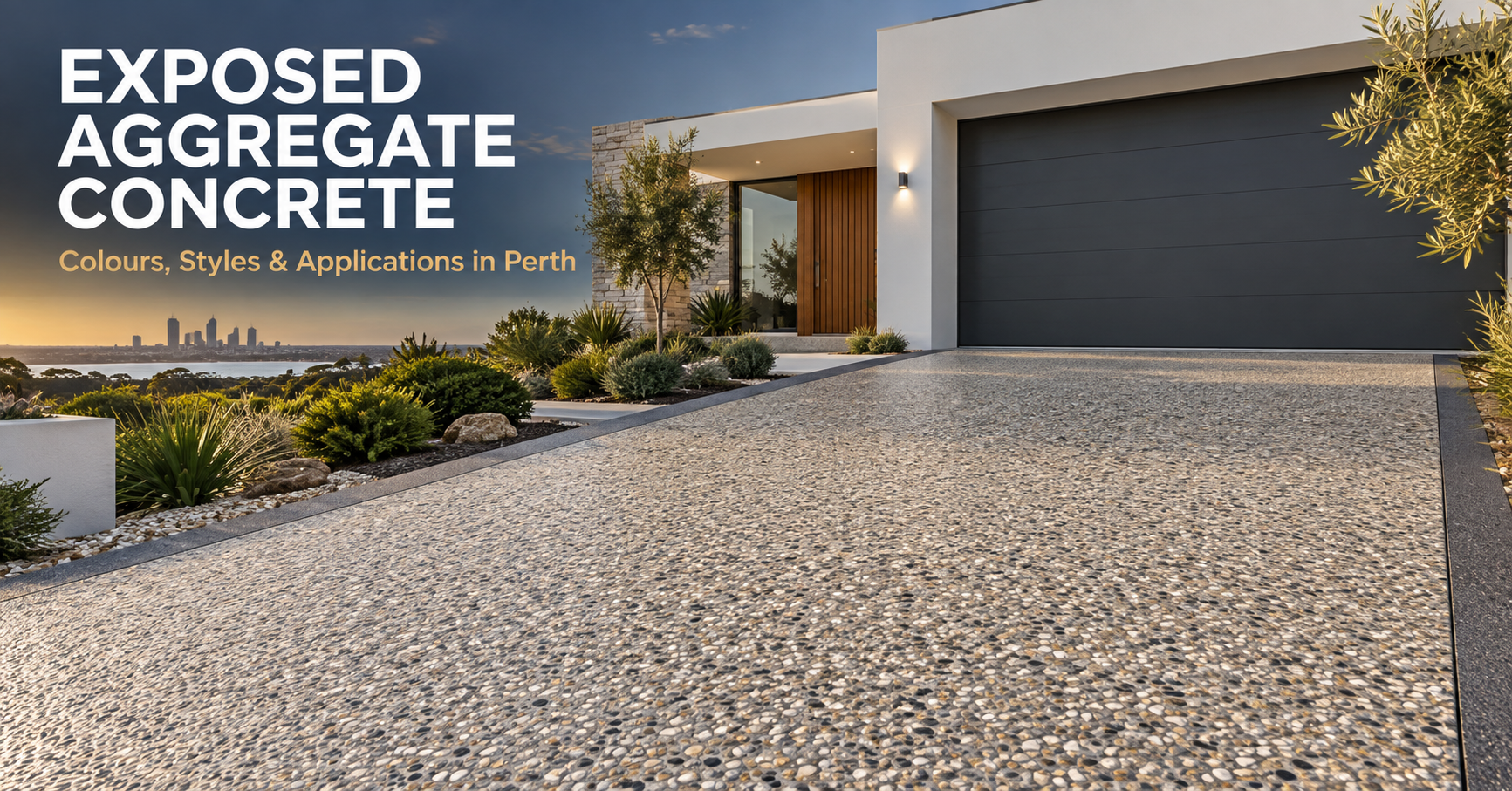
Exposed Aggregate Concrete in Perth: Colours, Styles and Applications

Exposed aggregate concrete is decorative concrete with the surface layer removed to reveal the stones inside the mix. The result is a textured finish with more colour and visual detail than standard grey concrete.

For Perth properties, it can be used across driveways, paths, pool surrounds, patios, entrances and commercial outdoor areas. A wide choice of aggregate and base colours also makes it easier to match the concrete with a home, development or business site.

This guide explains how exposed aggregate concrete is made, where it can be used and how to choose a finish that suits your property.

What Is Exposed Aggregate Concrete?

Concrete is usually made from cement, water, sand and aggregate. Aggregate is the stone or gravel within the mix. On standard concrete, the top surface is finished so the stones remain covered. With exposed aggregate concrete, a thin layer of cement paste is removed from the surface to reveal the selected stones.

The visible aggregate provides natural colour, pattern and texture. Suppliers such as Boral offer exposed aggregate ranges made with different Australian stones and concrete base colours.

How is the exposed finish created?

A typical installation follows these stages:

  1. The site is excavated and prepared to the required levels.
  2. Formwork, drainage provisions and reinforcement are installed where specified.
  3. The selected concrete mix is poured and levelled.
  4. A surface treatment is applied to control how the top layer sets.
  5. The surface paste is carefully washed away to expose the stones.
  6. The concrete is allowed to cure.
  7. A suitable sealer may be applied after the required curing period.

Timing matters during the exposure stage. Washing too early may loosen the stones, while washing too late can make it hard to achieve an even finish. This is one reason decorative concrete should be installed by a contractor with relevant project experience.

Why does every surface look different?

The final appearance depends on several choices:

  • Aggregate colour, shape and size
  • Concrete base colour
  • Depth of exposure
  • Mix placement and finishing
  • Sunlight, shade and moisture
  • Sealer type and finish

Natural stone can vary slightly between batches. A sample is useful for selecting a general colour direction, but it may not reproduce every detail of the finished slab.

Why Is Exposed Aggregate Concrete Popular in Perth?

Exposed aggregate concrete gives property owners a decorative surface without relying on a printed pattern. The colour comes from the concrete base and the real stones revealed at the surface.

It works with many Perth building styles, from coastal homes with pale exterior colours to modern buildings with charcoal roofs, dark frames and sharp landscape lines.

More visual detail than plain concrete

Plain concrete creates a simple and uniform surface. Exposed aggregate adds visible stones, colour variation and texture. This can turn a large driveway or entrance into part of the property’s exterior design.

A broad choice of colours

Mixes may contain white, cream, grey, brown, charcoal or mixed stones. The base concrete can also be coloured. These options allow the surface to complement brick, render, roofing, stone cladding, fencing and garden features.

Options for residential and commercial sites

The finish can be specified for houses, new developments, strata properties, shops, offices and shared outdoor spaces. The design and construction details still need to match the site, traffic and intended use.

Where Can Exposed Aggregate Concrete Be Used?

Driveways

An exposed aggregate driveway can add colour and texture to a large part of the front elevation. A mix can be selected to complement the roof, garage door, exterior walls and landscaping.

Borders can be added to frame the driveway or connect it with nearby paths. Control joints can also be planned as part of the layout rather than treated as an afterthought.

Where a driveway meets a road, the crossover may be subject to local requirements. Perth projects should be checked with the relevant local government or road authority. Main Roads Western Australia also publishes driveway guidance for roads under its control.

Paths, walkways and entrances

Paths often link several exterior materials. An aggregate mix can help tie together the driveway, front steps, garden walls and entry area. It may also be used to create a visible route from a parking area to a building entrance.

Patios and alfresco areas

Exposed aggregate can form a continuous outdoor surface around entertaining and dining areas. Neutral mixes can sit quietly beside furniture and planting, while darker or mixed-stone finishes can create stronger contrast.

Pool surrounds

The textured appearance suits many pool designs, but appearance is not the only requirement. Drainage, surface temperature, bare-foot comfort and slip resistance must be reviewed for the planned use.

Australia uses AS 4586 for the slip-resistance classification of new pedestrian surface materials. A contractor or project designer should help determine the right specification for a wet area rather than assuming that every exposed finish has the same performance.

Courtyards, garden areas and steps

The finish can be used for courtyards, garden paths, landings and steps. Matching or related mixes can visually connect these smaller spaces with the main driveway or patio.

Commercial and strata areas

Possible uses include building entrances, shared paths, outdoor dining areas, courtyards and pedestrian zones. Commercial and strata projects may have added requirements for access, traffic, drainage, safety, approvals and maintenance. These requirements should be recorded before the mix and finish are selected.

Exposed Aggregate Colours and Design Options

Light and neutral mixes

White, cream, sand and pale-grey stones can suit light render, coastal colour schemes and green landscaping. Lighter mixes may create a softer look across broad areas, although the actual heat and surface performance depend on the complete mix and site conditions.

Dark and charcoal mixes

Dark stones or a charcoal base can complement modern buildings, black window frames and dark garage doors. They can also produce a strong contrast beside light walls or pale landscape features.

Natural and mixed-stone finishes

Mixed stones create more colour variation across the slab. This can suit gardens and buildings that already use timber, brick or natural stone. Because the surface contains real aggregate, some variation is part of the finished character.

Concrete base colours

The base colour changes the way the exposed stones are seen. Pale aggregate in a dark base can appear bold and clear. Similar-toned stones and base concrete create a quieter, more blended finish.

Borders, bands and saw-cut patterns

A border may be made from plain concrete, coloured concrete or a contrasting aggregate mix. Bands can define parking areas, frame an entrance or separate a driveway from a path. Planned saw cuts can support the slab design while creating clean visual lines.

How to Choose the Right Finish for Your Property

Match the main exterior colours

Start with the fixed parts of the property:

  • Roof and gutters
  • Brick or render
  • Garage door
  • Window and door frames
  • Fencing
  • Retaining walls
  • Existing stone or paving

The concrete does not need to match every colour. It can pick up one main tone or provide controlled contrast.

View physical samples outdoors

Screen colours can change between devices. Small indoor samples may also look different under Perth sunlight. View physical samples outside and check them in sun and shade when possible.

Look at complete projects

A close-up image shows the stones, but it does not show how the mix reads across a full driveway or patio. Ask to see completed work from several distances. Look at the edges, joints, transitions and overall colour balance.

Plan connections between areas

Decide whether the driveway, path, patio and pool area should use one mix or related finishes. Using the same mix can create continuity. Using a second colour or border can separate areas without making the property look disconnected.

Check the surface when dry and wet

Many aggregates appear darker when wet or sealed. Ask how the chosen sealer may affect colour and sheen. This is especially useful for pool surrounds, shaded areas and places exposed to irrigation.

Exposed Aggregate Compared With Other Concrete Finishes

Finish Appearance Common reason for choosing it
Exposed aggregate Visible stone with natural colour variation Decorative texture and a custom mix selection
Plain concrete Uniform grey surface Simple appearance and fewer decorative choices
Coloured concrete More uniform colour through or over the surface Colour without exposed stones
Honed concrete Smoother surface with aggregate visible Refined decorative appearance in suitable areas
Concrete paving Individual units with repeated joints Pattern choice and unit-based layout

The right finish depends on the setting, desired appearance, surface requirements, budget and maintenance plan.

What Affects the Cost of Exposed Aggregate Concrete in Perth?

There is no single price that fits every exposed aggregate project. A written quote should reflect the actual site and design.

Main cost drivers include:

  • Total concrete area
  • Existing surface removal
  • Excavation and disposal
  • Access for workers and equipment
  • Ground and base preparation
  • Concrete thickness and specification
  • Reinforcement
  • Aggregate and base-colour selection
  • Curves, steps, borders and detailed formwork
  • Drainage and level changes
  • Sealing
  • Local approval or crossover requirements

A low headline rate may not include every stage. Ask for a written scope that states what preparation, concrete work, finishing, sealing and clean-up are included.

What to Ask an Exposed Aggregate Concrete Contractor

Use these questions during a site visit:

  1. Can you show me completed exposed aggregate projects?
  2. Can I view physical samples outdoors?
  3. Which colours will work with my building and landscaping?
  4. What site preparation is included in the quote?
  5. How will you manage levels and drainage?
  6. What reinforcement and concrete specification are proposed?
  7. Where will control joints and saw cuts be placed?
  8. Is sealing included, and what finish will the sealer create?
  9. Are council or crossover checks needed?
  10. What care is required after installation?

The answers should appear in the written scope where they affect price, appearance or construction.

Planning an Exposed Aggregate Concrete Project in Perth

Book a site assessment

An on-site visit allows the contractor to measure the area and inspect access, existing surfaces, levels, drainage and adjoining structures. Builders and property managers can also use the visit to confirm staging and access needs.

Approve the design and scope

The project documents should identify the chosen aggregate mix, base colour, borders, project area and sealer. They should also record removal work, preparation, drainage provisions and exclusions.

Confirm local requirements

Rules can differ between Perth local governments. Confirm any crossover, verge, drainage, traffic or access conditions that apply before work begins.

Review the completed work

At handover, check the agreed areas, edges, joints and transitions. Ask for clear instructions on access, curing, cleaning and future sealing.

Why Choose Perth Concrete And Landscaping?

Perth Concrete And Landscaping can help property owners, builders, developers and property managers plan exposed aggregate concrete that works with the wider outdoor design.

The process can include:

  • An on-site assessment in the Perth region
  • Help reviewing aggregate and colour options
  • Planning for driveways, paths, patios, pool surrounds and commercial areas
  • Coordination between concrete and surrounding landscape elements
  • A written quote based on the selected scope

Request an Exposed Aggregate Concrete Quote in Perth

The best mix should suit the property, the planned use and the wider landscape design. A site visit also helps identify preparation, access, levels and drainage needs before pricing is confirmed.

Contact Perth Concrete And Landscaping to request a quote, book an on-site visit or discuss your exposed aggregate concrete project in Perth.

Frequently Asked Questions

1. What is exposed aggregate concrete?

Exposed aggregate concrete is concrete finished so the stones within the mix are visible at the surface. Removing a thin layer of surface paste reveals the aggregate and creates a textured, decorative appearance. Product ranges such as Boral Exposé demonstrate how stone and base-colour choices can produce different finishes.

2. What colours are available for exposed aggregate concrete?

Options may include white, cream, sand, brown, grey, charcoal and mixed stones. The concrete base can also be coloured, so the same aggregate may look different in a light or dark base. Availability varies by supplier and location.

3. Where can exposed aggregate concrete be installed?

Common applications include driveways, paths, entrances, patios, pool surrounds, courtyards, steps and commercial pedestrian areas. The slab design and surface specification should suit the traffic, drainage and conditions at each location.

4. Does exposed aggregate concrete need to be sealed?

A compatible sealer is often used to support surface care and alter the final colour or sheen. The right product and application schedule depend on the concrete, exposure level, location and desired appearance. Follow the concrete supplier’s and sealer manufacturer’s written instructions.

5. How do I choose the right exposed aggregate mix for my Perth property?

Compare physical samples with your roof, walls, garage door, fencing and landscaping. View the samples outdoors, ask to see completed projects and check how the mix looks when dry, wet and sealed. A site visit with Perth Concrete And Landscaping can help narrow the options before a written quote is prepared.

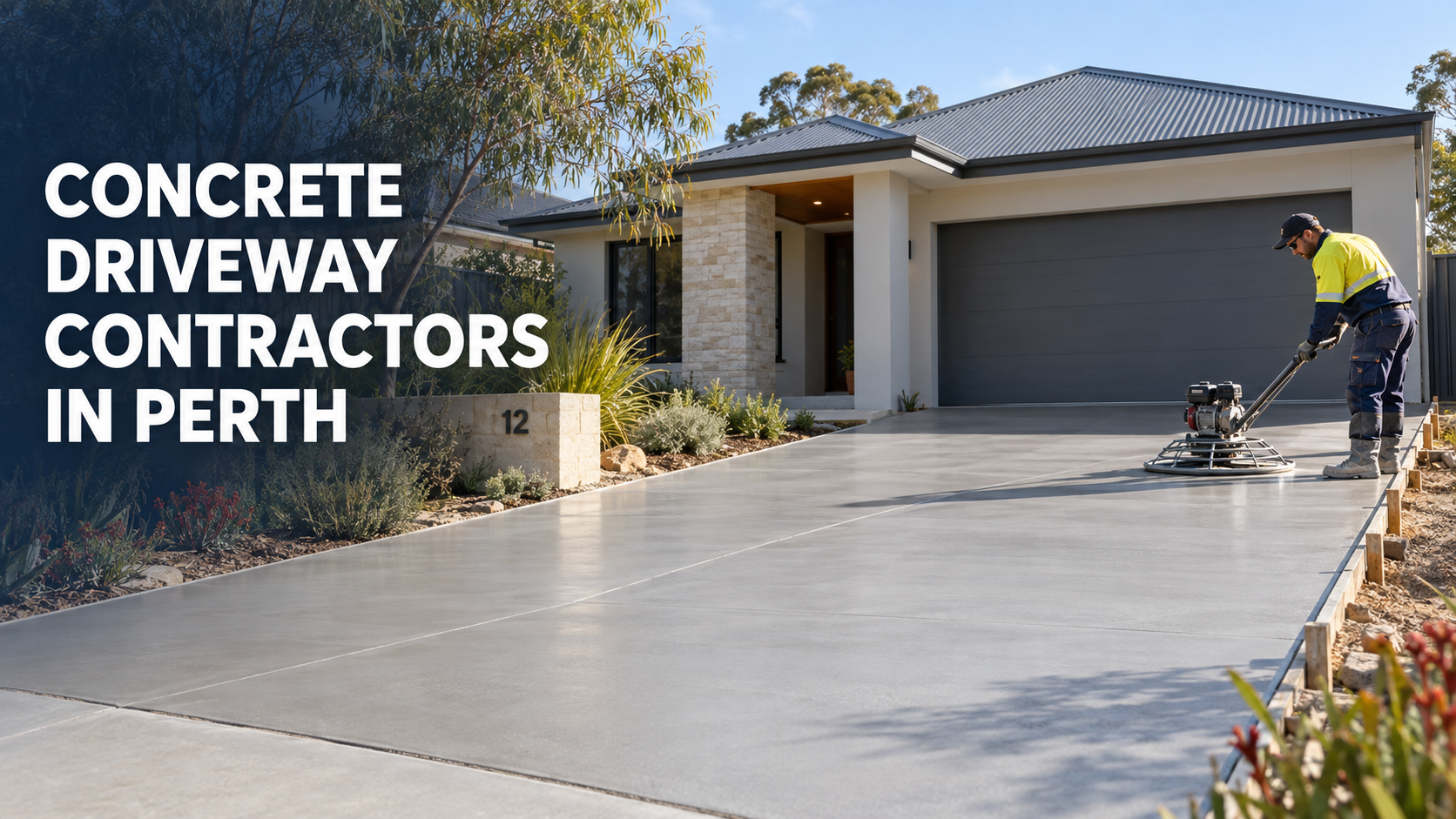
Concrete Driveway Contractors in Perth: How to Choose the Right Team

A concrete driveway must carry daily vehicle traffic, handle Perth weather and direct water away from buildings. Its performance depends on far more than the concrete visible at the surface.

Experienced concrete driveway contractors should assess the site, prepare the ground, plan drainage, install formwork and reinforcement, place the concrete, create joints and manage curing.

Perth Concrete and Landscaping provides concrete driveway services for homeowners, builders, developers, property managers and commercial property owners across Perth. An on-site visit helps the team recommend a suitable layout, finish and project scope for each property.

What Do Concrete Driveway Contractors Do?

Concrete driveway contractors manage the full installation process, from measuring the site to completing the final surface. Their work should cover both the appearance of the driveway and the structure supporting it.

On-Site Assessment and Measurements

A contractor should inspect the property before preparing the final quote. The assessment may include:

  • Driveway length, width and total area
  • Number and type of vehicles
  • Existing ground conditions
  • Slope and drainage direction
  • Access for excavation equipment
  • Nearby buildings, walls and gates
  • Trees, footpaths and kerbs
  • Underground and above-ground services
  • Connection to the road or crossover

Accurate measurements also help reduce unexpected changes after work starts.

Excavation and Ground Preparation

A long-lasting driveway needs a firm and stable base. Site preparation may involve removing an old driveway, excavating unsuitable material and installing a compacted sub-base.

The required preparation depends on the soil, previous site use, vehicle loads and driveway design. Concrete placed over loose or poorly prepared ground may be more likely to move or settle.

Formwork, Reinforcement and Concrete Placement

Formwork creates the shape, edges, levels and slope of the driveway. Reinforcement is then positioned according to the project specification.

The concrete must be placed and finished while it remains workable. This part of the project needs suitable planning because weather, site access and delivery timing can affect the pour.

Finishing, Joints and Curing

The chosen surface finish is applied after the concrete is placed. The contractor also installs or cuts joints in planned locations.

Joints help manage movement and guide shrinkage cracks. Reinforcement and joints can control cracking, but no responsible contractor should promise that outdoor concrete will never crack.

Curing helps concrete develop strength and reduces rapid moisture loss. Cement Concrete & Aggregates Australia provides guidance covering concrete driveway planning, construction, curing and maintenance.

Which Concrete Driveway Services Are Available?

The right service depends on whether the property needs a new driveway, replacement or added parking space.

New Concrete Driveway Installation

A new driveway can be installed for:

  • Newly built homes
  • Renovated properties
  • Subdivided blocks
  • Investment properties
  • Commercial premises
  • New parking or access areas

The layout should account for vehicle movement, garage access, gates, pedestrian areas and water runoff.

Old Driveway Removal and Replacement

Replacement may be suitable when an old driveway has widespread cracking, severe settlement, poor drainage or major surface damage.

The existing material normally needs to be broken up and removed before the ground can be assessed. A contractor should explain whether removal, disposal and new base preparation are included in the quote.

Small areas of damage do not always mean the full driveway needs replacement. Ask the contractor whether repair is practical and how the repaired area may look beside the existing concrete.

Driveway Extensions and Widening

A driveway extension can provide more parking or improve vehicle access. Before extending a driveway, check:

  • Property boundaries
  • Council crossover limits
  • Street trees and service pits
  • Drainage paths
  • Footpath connections
  • Access to gates and garages

New concrete placed beside an older slab may not have the same colour. The contractor should explain likely differences before work begins.

Which Concrete Finish Is Right for Your Driveway?

Concrete is available in several finishes. Your choice can affect appearance, texture, cleaning needs and project cost.

Plain Concrete Driveways

Plain concrete offers a simple and practical surface. It is commonly used where function and easy care are the main goals.

A broom finish can add texture to the surface. Ask the contractor to explain the proposed finish and how it will perform on sloped or frequently wet areas.

Coloured Concrete Driveways

Coloured concrete can connect the driveway with the home’s exterior, roof, fencing or landscape design.

Colours may appear different under changing light and weather conditions. The finished result can also vary from a small sample, so ask how the colour will be added and protected.

Exposed Aggregate Driveways

Exposed aggregate reveals selected stones within the concrete surface. It offers a textured appearance and is often chosen for modern homes and feature entrances.

Ask to see completed projects or physical samples. The aggregate blend, exposure method and sealer can change the final appearance.

Decorative Concrete Finishes

Decorative options can include borders, patterns, contrasting sections and custom layouts. These finishes can create a distinctive entrance, but they may need added labour and care.

Finish Appearance Care level Common application Question to ask
Plain concrete Clean and simple Low Homes and utility areas Which surface texture is included?
Coloured concrete Coordinated colour Low to moderate Modern homes How is the colour added?
Exposed aggregate Textured and decorative Moderate Feature driveways Can I view the aggregate sample?
Decorative concrete Custom appearance Varies Entrances and designed spaces What upkeep will the finish need?

What Should Be Checked Before Driveway Work Starts?

Pre-construction checks can prevent delays, layout problems and unexpected costs.

Council Crossover Approval

The crossover is generally the section connecting the property boundary to the road. Approval rules vary between councils.

The City of Perth states that a crossover between the road edge and property must be approved before work begins. Its application also asks for a sketch showing dimensions and nearby trees, poles and pits.

A property elsewhere in metropolitan Perth will fall under a different council. The owner or contractor should check that council’s current rules before starting work.

Underground Services and Site Access

The work area should be checked for service lines, pipes, pits, irrigation and other site features.

Contractors also need safe access for machinery, concrete delivery and waste removal. Restricted access can affect the method, schedule and price.

Driveway Slope and Stormwater

The driveway should be planned so water does not flow toward the house, garage or neighbouring property. The contractor may recommend suitable falls, drains or channels based on the site.

Drainage requirements can differ between councils and properties. Any proposed connection to council drainage must follow the relevant approval process.

Trees, Footpaths, Kerbs and Verges

Street trees and public infrastructure may limit the crossover’s position or width. A new driveway should not be planned on the assumption that a tree, pole, pit or kerb can be moved.

These items should be identified during the site visit and shown on any required application.

Permits, Registration and Insurance

Ask the contractor which permits or approvals apply to the job. Requirements can depend on the type, permit status and value of the work.

WA homeowners can use the Building and Energy licence and registration search to check any registration required for a project.

You should also ask for proof of current public liability insurance and confirm who is responsible for council applications.

Why Site Preparation Matters in Perth

The finished surface may look good on the day of the pour, but the work underneath can affect how the driveway performs over time.

Soil and Existing Ground Conditions

Perth properties can have sandy, filled or disturbed ground. Site conditions may also vary within a single property.

A contractor should inspect the area and explain the excavation and base preparation included in the scope. Deeper excavation or added base material may be needed where the ground is soft or unstable.

Sub-Base Preparation and Compaction

A compacted sub-base creates a stable platform for the driveway. Its material and depth should suit the site and intended vehicle use.

Ask whether the quote includes:

  • Excavation depth
  • Removal of unsuitable material
  • Sub-base material
  • Compaction
  • Final level checks

Drainage Planning

Drainage should be planned before formwork and concrete placement. Once the slab is installed, changing its slope can be difficult and costly.

The contractor should explain where surface water will go and whether drains or channels are needed.

Formwork and Levels

Formwork holds the wet concrete in place and establishes the driveway’s shape. Levels should connect correctly with the garage, paths, gates, kerb and surrounding landscape.

Reinforcement, Concrete Thickness and Joints

Driveway construction details should match the property, ground conditions and expected traffic.

How Is Driveway Thickness Chosen?

There is no single specification for every driveway. Thickness may depend on:

  • Passenger cars or heavier vehicles
  • Soil and sub-base conditions
  • Driveway slope
  • Council crossover specifications
  • Concrete design
  • Engineering or permit requirements

Ask for the proposed slab specification in writing instead of relying on a verbal description.

What Does Reinforcement Do?

Reinforcement helps control crack width and supports the intended slab performance. It must be correctly supported and positioned within the concrete.

Mesh left on the ground may not sit at the intended level within the slab. Ask how the contractor will support the reinforcement during the pour.

Why Are Control and Isolation Joints Used?

Control joints create planned locations for shrinkage movement. Isolation joints separate the driveway from fixed structures such as walls, columns or existing slabs.

Joint type, spacing and position should be planned before the concrete is placed. CCAA guidance explains that concrete pavement joints include movement joints and joints used to control cracking.

Can a Contractor Promise That Concrete Will Never Crack?

No honest contractor can guarantee that outdoor concrete will remain completely free from cracks.

Concrete can shrink as it loses moisture. Temperature changes, soil movement, tree roots and heavy loads may also affect it. Good preparation, reinforcement, joint placement and curing can reduce risk and help manage cracks.

How Long Does a Concrete Driveway Take to Install?

The project period depends on driveway size, site access, excavation, finish, weather and approval requirements.

A typical sequence includes:

  1. Site assessment and quote
  2. Finish and scope confirmation
  3. Council or service checks
  4. Excavation and removal
  5. Base preparation and formwork
  6. Reinforcement installation
  7. Concrete placement and finishing
  8. Joint work and curing
  9. Clean-up and final inspection

When Can Vehicles Use the Driveway?

Concrete gains strength over time. The safe access date depends on the mix, slab design, weather and curing method.

Do not drive on the new surface until the contractor confirms it is ready. Ask for pedestrian and vehicle access dates in writing before the job begins.

How Much Does a Concrete Driveway Cost in Perth?

Concrete driveway prices vary because each property has different measurements and site conditions. A contractor normally needs an on-site inspection to prepare an accurate quote.

The price may be affected by:

  • Total driveway area
  • Concrete thickness and specification
  • Excavation depth
  • Old surface removal
  • Waste disposal
  • Ground and sub-base conditions
  • Reinforcement
  • Site access
  • Drainage work
  • Plain, coloured or exposed aggregate finish
  • Borders and decorative details
  • Council crossover requirements
  • Kerb, path or landscape connections

A low quote may exclude excavation, waste removal, drainage or curing. Compare the written scope rather than the final number alone.

How to Compare Concrete Driveway Contractors

Use the same checklist for each company so you can compare similar work.

Review Similar Completed Driveways

Ask for recent examples that match your preferred finish. If possible, look at projects completed more than a few weeks ago rather than only newly poured concrete.

Check Required Registration and Insurance

Confirm any registration required for the project through the WA public register. Request proof of insurance directly from the contractor.

Ask Who Will Carry Out the Work

Find out whether the quoted company will complete the project or use subcontractors. Ask who will supervise the site and who you should contact with questions.

Request a Written Scope and Itemised Quote

The quote should state:

  • Measured area
  • Excavation and removal
  • Sub-base preparation
  • Concrete specification
  • Reinforcement
  • Finish and colour
  • Drainage items
  • Joints
  • Curing
  • Council-related work
  • Clean-up
  • Payment stages
  • Exclusions

Confirm Preparation, Reinforcement and Joint Details

These details may be hidden once the concrete is poured. Ask for them before accepting the quote.

Ask About Curing and Aftercare

The contractor should explain how the concrete will be cured, when it can be used and how the surface should be cleaned.

Review Payment and Variation Terms

For home building contracts covered by WA legislation, deposit and payment rules may apply. Building and Energy guidance states that the maximum deposit is generally 6.5% for contracts covered by the Home Building Contracts Act. The Act does not apply to contracts below $7,500 or above $500,000.

Ask for written approval and pricing before any variation work begins.

Get Warranty Terms in Writing

Ask what the workmanship warranty covers, how long it lasts and which conditions are excluded. Keep your quote, contract, payment records and care instructions.

Questions to Ask During the Site Visit

Take these questions to each contractor meeting:

  • What ground preparation is included?
  • How will water drain from the driveway?
  • What slab specification suits my vehicles and site?
  • What reinforcement will be installed?
  • Where will joints be placed?
  • Does the crossover need council approval?
  • Who will handle the application?
  • Is old driveway removal included?
  • Which finish, colour and sealer are included?
  • When can people and vehicles use the driveway?
  • How will changes be approved and priced?
  • What written warranty is supplied?

Warning Signs When Reviewing a Driveway Quote

Be cautious when a contractor:

  • Offers a final price without inspecting the site
  • Gives no written scope
  • Leaves excavation or base preparation unclear
  • Does not state the concrete or reinforcement details
  • Has no drainage or joint plan
  • Cannot explain council responsibilities
  • Requests a large payment without clear terms
  • Does not provide written receipts
  • Has no process for variations
  • Cannot show relevant completed projects
  • Pressures you to accept the quote immediately

Why Choose Perth Concrete and Landscaping?

Perth Concrete and Landscaping provides on-site assessments for new driveways, replacements, extensions and concrete finish options.

The team can discuss:

  • Your preferred driveway layout
  • Plain, coloured and exposed aggregate finishes
  • Existing surface removal
  • Ground preparation
  • Drainage needs
  • Vehicle access
  • Crossover considerations
  • Project scope and quote inclusions

A site visit allows the proposed work to reflect the property’s actual measurements, access and ground conditions.

Request an On-Site Concrete Driveway Quote

Planning a new or replacement driveway in Perth?

Book a site visit with Perth Concrete and Landscaping to discuss the layout, finish, ground preparation and site requirements. Request a detailed written quote based on your property and intended use.

Frequently Asked Questions

1. Do I need council approval for a concrete driveway in Perth?

Approval may be required for the crossover between the property boundary and the road. Each Perth council can have its own process and specifications. For example, the City of Perth requires crossover approval before work begins.

2. How thick should a concrete driveway be?

Thickness should be selected for the ground conditions, expected vehicles, concrete design and council requirements. The CCAA residential driveway guidance covers specification and construction points. Ask your contractor to state the proposed thickness and supporting details in the quote.

3. Does reinforcement stop a concrete driveway from cracking?

Reinforcement can help control crack width, but it cannot guarantee a crack-free driveway. Base preparation, joint placement, concrete design and curing also affect slab performance. CCAA guidance describes reinforcement and joints as parts of the overall driveway design.

4. How long before a new driveway can be used?

The waiting period depends on the concrete mix, weather, slab design and curing. Pedestrian access may be allowed before vehicle access. Follow the contractor’s written instructions and do not park on the driveway until approval is given. Boral’s Australian Concrete Guide explains that curing keeps concrete damp while strength develops.

5. Which concrete finish is suitable for a Perth driveway?

Plain concrete suits practical projects, while coloured concrete and exposed aggregate offer more design choice. The suitable option depends on the home, budget, desired texture and care needs. Ask to view finished samples and completed local projects before choosing.

How to Choose Reliable Concrete Contractors in Perth

Choosing a concrete contractor is not only about finding the lowest quote. The quality of the site preparation, concrete mix, reinforcement, drainage, finishing and curing can affect how the finished surface looks and performs.

For homeowners, builders, property managers and commercial property owners, the right contractor should offer clear advice, a detailed scope of work and proof that they can complete the job safely.

This guide explains what concrete contractors do, the residential services they provide and the checks you should make before hiring a contractor in Perth.

What Does a Concrete Contractor Do?

A concrete contractor plans, prepares, pours and finishes concrete surfaces. Their work may include driveways, pathways, patios, pool surrounds, shed slabs, garage slabs and decorative concrete.

A professional concreting project usually includes:

  • Inspecting and measuring the site
  • Checking access, ground conditions and drainage
  • Removing existing concrete or soil when required
  • Preparing and compacting the base
  • Installing formwork and reinforcement
  • Ordering and placing the specified concrete
  • Creating falls, joints and the selected surface finish
  • Curing the concrete and protecting it while it gains strength
  • Cleaning the work area and completing a final inspection

The Guide to Concrete Construction from Cement Concrete & Aggregates Australia covers concrete materials, specification, placement and performance. It shows why the completed surface is only one part of a sound concreting job.

Residential Concrete Services in Perth

Concrete contractors may offer several services. Ask whether the contractor has recent experience with the type of project you need.

Concrete driveways and crossovers

A driveway must handle vehicle traffic while directing water away from the house and other structures. The quote should explain the excavation, base preparation, slab thickness, reinforcement, surface finish, joints and drainage included in the work.

The section between a property boundary and the road is normally called a crossover. Approval rules differ between councils. For example, the City of Perth requires crossover approval before that work starts.

Pathways and entrance areas

Concrete paths can provide clean, low-maintenance access around a property. The layout should account for doors, garden beds, gates, downpipes and natural water flow. Discuss the proposed width, falls, finish and connection points during the site visit.

Patios and outdoor entertaining areas

A patio needs a practical layout and a finish suited to outdoor use. Planning may include furniture locations, steps, nearby landscaping, drainage and links to the house. Decorative choices include coloured concrete, exposed aggregate and honed finishes.

Pool surrounds

Pool surrounds need careful set-out and drainage. Ask how the new work will meet the pool edge, fences, gates and nearby paving. Surface texture and ongoing care should also be discussed before selecting a finish.

Shed and garage slabs

Slab requirements depend on the structure and its intended loads. The contractor should work from the relevant plans or specifications and confirm the earthworks, base, formwork, reinforcement and concrete included in the quote.

Decorative concrete

Decorative concrete can change the colour and texture of an outdoor area. Common choices include exposed aggregate, coloured concrete, honed concrete and sealed finishes. View completed projects in person where possible, because online photographs may not show the exact colour or texture.

Concrete removal and replacement

Badly cracked, sunken or poorly drained concrete may need removal. Ask how the old material will be taken away, how the cause of the damage will be checked and how the replacement area will connect with existing surfaces.

Why the Right Concrete Contractor Matters

Concrete hardens into a permanent surface, so errors can be costly to repair. A good-looking finish will not correct a weak base, poor drainage or unsuitable joint placement.

An experienced contractor should be able to explain:

  • How the ground will be excavated and compacted
  • Which base material will be used
  • How water will move across and away from the slab
  • What concrete specification is proposed
  • Where reinforcement and joints will be placed
  • Which finish suits the area
  • How the concrete will be cured
  • When people and vehicles can use the surface

Clear answers do not guarantee a problem-free project, but they help you compare contractors using the same project requirements.

15 Checks Before Hiring Concrete Contractors in Perth

1. Confirm the contractor’s business details

Ask for the legal business name, ABN, contact details and business address. Check that the name on the quote matches the person or company taking responsibility for the work.

2. Check whether builder registration applies

Not every small concreting job has the same registration requirements. In WA, builder registration can apply when work requires a building permit and passes set value thresholds. The WA Government builder registration guide explains the current rules.

If registration applies, search the relevant public register and check that the details are current.

3. Ask for proof of insurance

Request a current certificate of currency for public liability insurance. Depending on the job, other insurance or workers compensation cover may also be relevant. Check the insured name, policy period and level of cover.

4. Review similar completed projects

Ask to see recent driveways, patios, paths or slabs similar to your project. Look at the edges, drainage, surface consistency, joints and how the concrete meets other areas.

5. Speak with recent customers

Ask whether the contractor can provide references. Useful questions include:

  • Did the work start and finish close to the agreed dates?
  • Were changes explained before extra work began?
  • Was the final price consistent with the agreed scope?
  • Was the site left clean?
  • How did the contractor respond to any problems?

6. Request an on-site inspection

A site visit lets the contractor check measurements, access, levels, soil, demolition needs and drainage. It also gives you a chance to ask how the work will be carried out.

7. Get a detailed written quote

The quote should identify what is included and excluded. Ask for details covering:

  • Total area and measurements
  • Removal and disposal of existing material
  • Excavation depth and base preparation
  • Formwork and reinforcement
  • Concrete specification and proposed thickness
  • Surface finish, colour and sealer
  • Drainage and falls
  • Joint locations
  • Permit or council fees
  • Site access and protection
  • Cleanup and waste removal
  • Payment stages
  • Warranty or defect process

8. Compare the scope, not only the total

Two quotes may describe very different jobs. One may include removal, extra base preparation, reinforcement or sealing while another leaves those items out. Compare every line before deciding which proposal offers better value.

9. Ask who will complete the work

Find out whether the person quoting the project will be on site and whether subcontractors will be used. Ask who will supervise the work and who you should contact during the project.

10. Confirm permits and council approvals

Permit needs depend on the project and local government area. WA Building and Energy advises property owners to contact their local government about application requirements and local laws. See the WA building approvals guidance.

The written scope should state who will apply, supply drawings and pay fees.

11. Discuss site preparation

Ask the contractor to explain how much material will be removed, how the subgrade will be checked and how the base will be compacted. If soft ground, tree roots, old fill or poor drainage is found, ask how any extra work will be priced and approved.

12. Ask about reinforcement and joints

The contractor should explain the proposed reinforcement and joint layout. These details should suit the slab’s use, dimensions and design requirements. Avoid treating reinforcement or joints as a one-size-fits-all item.

13. Check the silica-dust controls

Cutting, drilling or grinding concrete can release respirable crystalline silica. Safe Work Australia states that concrete can contain crystalline silica and that processing it can create hazardous dust.

Ask how the contractor will control dust, protect people nearby and clean the site. Wet methods, suitable extraction and correct protective equipment may form part of the work method.

14. Put payment stages and changes in writing

Do not rely on verbal promises. The contract should set out the price, payment stages, scope and process for changes.

For home-building contracts covered by WA law, contracts must be written and signed, deposits are restricted, and progress payments must relate to work already completed. Current details are available in the WA Government guide for building or renovating a home.

WA guidance also states that covered contract changes must be written, dated and signed before the changed work begins. See the obligations for registered building service providers.

15. Complete a final inspection

Walk through the project before the final payment. Check the completed area against the written scope. Record any agreed corrections in writing and keep copies of the quote, contract, variations, invoices, permits and care instructions.

Questions to Ask During the Site Visit

Take these questions to each appointment:

  1. What site preparation does this project need?
  2. How will you manage drainage and surface falls?
  3. What concrete specification and slab thickness do you propose?
  4. What reinforcement will be used?
  5. Where will the joints be placed?
  6. Which finish best suits this area and how should it be maintained?
  7. Do I need a permit or crossover approval?
  8. Who will arrange approvals and inspections?
  9. How will you manage dust, noise and access?
  10. What could cause the price or schedule to change?
  11. How will changes be approved?
  12. What curing process will be used?
  13. When can the area take foot or vehicle traffic?
  14. What warranty or defect terms are included?
  15. Who will supervise the project?

Warning Signs When Comparing Contractors

Be cautious when a contractor:

  • Refuses to provide a written quote
  • Will not supply business or insurance details
  • Cannot explain the preparation work
  • Gives no details about drainage, reinforcement or joints
  • Requests a payment structure that does not match applicable WA rules
  • Pushes you to approve the job immediately
  • Wants changes agreed only by phone
  • Offers no recent project examples
  • Gives unclear warranty terms
  • Provides a price far below other quotes without explaining why

A low price may be genuine, but you should know whether materials, preparation or cleanup have been removed from the scope.

How Much Does Residential Concreting Cost in Perth?

There is no reliable single price for all Perth concreting projects. The final quote can change based on:

  • Total area and concrete volume
  • Site access
  • Demolition and disposal
  • Excavation and base preparation
  • Ground conditions
  • Reinforcement
  • Concrete specification
  • Surface finish and colour
  • Pumping or special equipment
  • Drainage work
  • Steps, curves and detailed formwork
  • Council applications or permits
  • Sealing and aftercare

Ask at least two or three contractors to quote the same written scope. This makes it easier to identify missing items and understand large price differences.

Perth Permits, Contracts and Local Requirements

Building permits and local rules

Your local government assesses building permit applications and can explain local requirements. Never assume that approval in one Perth council area means the same rule applies in another.

Driveway crossover approval

A crossover connects private property with the road through the verge. Councils may set requirements for width, location, levels, nearby trees and public infrastructure. Confirm approval needs before booking the pour.

Written contracts and payments

WA’s Home Building Contracts Act protections apply to certain residential work. Government guidance states that covered contracts from $7,500 to $500,000 must be written and signed. It also states that the maximum deposit is 6.5% and that progress payments must cover work performed. Check the latest rules for your project before signing.

Home indemnity insurance

Home indemnity insurance may be required for residential building work that needs a building permit and is valued above $20,000. Some associated work has different treatment. The WA Government homeowner guide explains when the cover may apply and what certificate the builder must provide.

These rules depend on the type, value and approval status of the work. Seek guidance from WA Building and Energy or your local council if you are unsure.

Concrete Finish Options for Perth Properties

Plain concrete

Plain concrete offers a simple finish for utility areas, paths and some driveways. Ask whether the surface texture and appearance suit the location.

Coloured concrete

Colour can help the surface match a home or landscape design. Ask to view physical samples and completed work, as colour can look different under changing light.

Exposed aggregate

Exposed aggregate reveals selected stones at the surface. Aggregate choice, exposure level, sealing and workmanship all affect the final appearance.

Honed concrete

Honing creates a smoother decorative finish by grinding the surface. Ask where the contractor recommends using it and what care it needs.

Sealed decorative concrete

A sealer can change appearance and maintenance needs. Ask about the product, finish, reapplication schedule and care instructions before the job begins.

Why Local Perth Experience Helps

A contractor with recent Perth experience should understand local council processes, common site-access issues and the planning needed for outdoor concrete work. Local experience can also help when coordinating material supply, equipment and project timing.

Do not rely on the word “local” alone. Ask for recent projects, clear documentation and direct answers about your site.

Book a Detailed On-Site Concreting Quote

The best quote starts with a clear view of the property and the work required. Perth Concrete and Landscaping can inspect your site, discuss suitable concrete options and prepare a written quote for your project.

Book an on-site visit to discuss your driveway, pathway, patio, pool surround, slab or other residential concrete work in Perth.

Frequently Asked Questions

1. How do I choose a reliable concrete contractor in Perth?

Check the contractor’s business details, relevant registration, insurance, recent work and customer references. Request an on-site inspection and a detailed written scope covering preparation, concrete, reinforcement, joints, drainage, finish, payments and warranty terms. The WA Government registration guide explains when registered building contractors are required.

2. What should a concrete quote include?

A strong quote should list measurements, demolition, excavation, base preparation, reinforcement, concrete specifications, finish, drainage, joints, approvals, waste removal, payment stages and warranty terms. It should also show exclusions and explain how extra work will be approved.

3. Do I need council approval for a concrete driveway in Perth?

Approval depends on the work and local council. A crossover on council-controlled land often needs approval. The City of Perth, for example, requires approval before crossover work starts. Contact the council responsible for your property for the rules that apply there.

4. How long should new concrete cure before it is used?

The required waiting time depends on the concrete, weather, slab design and intended use. Foot traffic and vehicle traffic may have different timeframes. Follow the contractor’s written instructions and do not use the surface early. CCAA provides a dedicated concrete curing data sheet explaining why curing affects concrete quality.

5. What payment rules apply to concrete work in WA?

The answer depends on the type and value of the contract. For home-building contracts covered by WA law, government guidance states that deposits cannot exceed 6.5% and progress payments must relate to completed work or supplied materials. Review the current WA contract guidance before signing.

10 Benefits of Professional Concrete Landscape Services for Your Property

When it comes to improving the beauty, functionality, and value of your outdoor space, concrete landscape services are one of the smartest investments you can make. Whether you want a stylish driveway, a durable patio, elegant pathways, or a modern outdoor entertaining area, professionally designed concrete features can completely transform your property.

At Perth Concrete Landscaping, we help homeowners create outdoor spaces that are attractive, long-lasting, and easy to maintain. From custom designs to quality workmanship, professional landscaping ensures your investment delivers lasting value.

In this guide, we’ll explore the top 10 benefits of hiring professionals for your concrete landscaping project and why it’s worth choosing experienced experts.

Why Choose Professional Concrete Landscape Services?

Many homeowners think concrete is only for driveways or footpaths. In reality, modern concrete landscape services offer endless design possibilities that combine durability with style. Professional contractors understand how to design outdoor spaces that complement your home while standing up to Perth’s changing weather conditions.

With expert planning, quality materials, and skilled installation, your landscaping project becomes a long-term investment rather than a short-term fix.

1. Improve Your Property’s Curb Appeal

First impressions matter.

Beautifully designed Concrete Landscaping instantly enhances the appearance of your property. Decorative pathways, elegant driveways, retaining walls, and outdoor entertainment areas create a clean and modern look that makes your home stand out.

Professional finishes also ensure every detail blends perfectly with your existing landscape.

Popular options include:

  • Decorative driveways
  • Garden edging
  • Concrete pathways
  • Outdoor patios
  • Courtyard paving

2. Increase Property Value

A professionally landscaped property attracts more buyers and often commands a higher selling price.

Quality concrete landscape services improve both appearance and functionality, making your home more appealing in the competitive Perth property market.

Potential buyers appreciate outdoor areas that require minimal maintenance while offering attractive spaces for entertaining and relaxation.

3. Exceptional Durability

Concrete is one of the strongest landscaping materials available.

Unlike timber that can rot or paving that may shift over time, professionally installed concrete is built to last for decades with minimal repairs.

When installed correctly, concrete can withstand:

  • Heavy foot traffic
  • Vehicle loads
  • Extreme weather
  • UV exposure
  • Daily wear and tear

This makes it ideal for residential and commercial properties alike.

4. Low Maintenance Requirements

One of the biggest advantages of concrete landscape services is the minimal maintenance they require.

Unlike lawns that need constant mowing or timber decking that requires regular staining, concrete surfaces are easy to care for.

Simple maintenance usually includes:

  • Sweeping debris
  • Occasional washing
  • Sealing every few years
  • Minor crack inspections

This saves homeowners both time and ongoing maintenance costs.

5. Endless Design Possibilities

Today’s decorative concrete landscaping offers far more than plain grey concrete.

Modern finishing techniques allow you to create beautiful outdoor areas using:

  • Exposed aggregate
  • Coloured concrete
  • Stamped concrete
  • Honed finishes
  • Textured surfaces
  • Patterned designs

Professional installers can customise colours, textures, and finishes to perfectly match your home’s style.

6. Safe and Functional Outdoor Spaces

Safety is just as important as appearance.

Professional concrete landscape contractors understand how to design outdoor surfaces that reduce slipping hazards and improve accessibility.

Proper drainage, non-slip finishes, and level pathways make outdoor spaces safer for:

  • Children
  • Elderly family members
  • Visitors
  • Pets

Good planning also prevents water pooling that can damage landscaping over time.

7. Perfect for Outdoor Entertaining

Outdoor living has become increasingly popular across Perth.

Whether you’re hosting family barbecues, relaxing with friends, or creating a play area for children, professionally installed concrete patios provide a solid, attractive foundation.

A well-designed entertaining space can include:

  • BBQ areas
  • Seating spaces
  • Fire pit surrounds
  • Pool surrounds
  • Outdoor dining areas

Professional design ensures everything flows naturally throughout your landscape.

8. Cost-Effective Long-Term Investment

Although professional installation may cost more initially than DIY options, it provides much better long-term value.

Experienced contractors avoid common problems like:

  • Uneven surfaces
  • Poor drainage
  • Early cracking
  • Incorrect foundations
  • Structural issues

Choosing skilled professionals reduces future repair costs while extending the life of your investment.

9. Custom Solutions for Every Home

Every property is unique.

Professional residential concrete landscaping is tailored to your home’s size, layout, style, and budget.

Experienced contractors carefully assess:

Property layout

Ensuring every feature fits naturally within the available space.

Drainage

Protecting your home and garden from water damage.

Functionality

Designing spaces that suit your lifestyle and daily needs.

Aesthetics

Creating attractive outdoor areas that complement your property’s architecture.

The result is a landscape designed specifically for your family.

10. Professional Workmanship Delivers Better Results

The quality of installation directly affects the lifespan and appearance of your landscaping.

Experienced concrete landscape contractors use proper preparation techniques, premium materials, and industry best practices to ensure outstanding results.

Professional workmanship provides:

  • Accurate measurements
  • Strong foundations
  • Quality finishing
  • Long-lasting durability
  • Excellent attention to detail

This level of craftsmanship simply cannot be matched by shortcuts or inexperienced installation.

Why Perth Homeowners Trust Professional Concrete Landscaping

Choosing experienced professionals means every stage of your project is handled correctly—from planning and design through to construction and finishing.

At Perth Concrete Landscaping, we focus on creating outdoor spaces that combine durability, functionality, and visual appeal. Whether you’re upgrading an existing garden or building a completely new outdoor area, our team delivers quality solutions designed to last.

Our expertise in Concrete Landscaping and decorative concrete landscaping allows us to create custom outdoor spaces that suit every property and lifestyle.

Tips for Choosing the Right Concrete Landscaping Company

Before hiring a contractor, consider the following:

  • Check previous project portfolios.
  • Read customer reviews and testimonials.
  • Ask about materials and warranties.
  • Ensure the contractor is licensed and experienced.
  • Request a detailed written quote.
  • Choose a company that offers customised design solutions.

Working with experienced professionals helps ensure your project is completed on time, within budget, and to a high standard.

Conclusion

Investing in professional concrete landscape services is one of the best ways to improve your property’s appearance, functionality, and long-term value. From stunning driveways and stylish patios to decorative pathways and custom outdoor living spaces, quality concrete landscaping offers durability, low maintenance, and endless design possibilities.

If you’re ready to transform your outdoor space, Perth Concrete Landscaping is here to help. Our experienced team specialises in designing and delivering high-quality concrete landscape services that are tailored to your needs and built to stand the test of time.

Contact Perth Concrete Landscaping today for a free consultation and let us create a beautiful, durable outdoor space that you’ll enjoy for years to come.

The Ultimate Guide to Concrete Landscaping for Modern Homes

Modern homeowners are looking for outdoor spaces that are stylish, functional, and easy to maintain. One of the best ways to achieve this is through Concrete Landscaping. Whether you’re designing a new outdoor area or renovating an existing one, concrete offers unmatched durability, versatility, and aesthetic appeal.

At Perth Concrete Landscaping, we help homeowners create stunning outdoor environments that combine beauty with long-lasting performance. From elegant pathways and decorative patios to durable driveways and retaining walls, concrete landscaping provides endless design possibilities.

In this comprehensive guide, you’ll discover everything you need to know about concrete landscaping, its benefits, popular design ideas, and how professional installation can transform your property.

What is Concrete Landscaping?

Concrete Landscaping refers to the use of concrete elements to enhance the appearance, functionality, and value of outdoor spaces. Unlike traditional landscaping that relies heavily on plants and natural materials, concrete creates structured, durable, and low-maintenance features that complement modern home designs.

Common concrete landscaping features include:

  • Driveways
  • Patios
  • Garden pathways
  • Pool surrounds
  • Outdoor entertaining areas
  • Retaining walls
  • Concrete edging
  • Garden steps
  • Decorative concrete surfaces

With modern finishing techniques, concrete is no longer plain grey. Today’s decorative options allow homeowners to enjoy stylish textures, colours, and patterns that resemble natural stone, brick, timber, or slate.

Why Concrete Landscaping is Perfect for Modern Homes

Modern homes focus on clean lines, open spaces, and practical living. Concrete fits perfectly with this architectural style.

Here are some reasons why homeowners choose Concrete Landscaping:

Exceptional Durability

Concrete withstands harsh weather conditions, heavy foot traffic, and vehicle loads. Properly installed concrete can last for decades with minimal maintenance.

Low Maintenance

Unlike timber decking or paving, concrete requires very little upkeep. Occasional cleaning and resealing help maintain its appearance for years.

Cost-Effective

Concrete provides excellent long-term value. While natural stone may have a higher initial cost, concrete offers a premium look at a more affordable price.

Design Flexibility

Modern finishing methods allow concrete to mimic premium materials while offering superior durability.

Popular finishes include:

  • Exposed Aggregate
  • Coloured Concrete
  • Stamped Concrete
  • Polished Concrete
  • Honed Concrete

Popular Concrete Landscaping Ideas

Choosing the right design can dramatically improve your outdoor living experience.

1. Decorative Concrete Driveways

Your driveway creates the first impression of your home.

Using decorative concrete landscaping, homeowners can choose from exposed aggregate, coloured finishes, or stamped patterns to create an elegant entrance.

Benefits include:

  • Increased curb appeal
  • Slip-resistant surfaces
  • Long-lasting durability
  • Easy maintenance

2. Modern Outdoor Patios

Outdoor entertaining areas have become an essential feature of modern homes.

Concrete patios provide:

  • Smooth, level surfaces
  • Weather resistance
  • Custom colours
  • Large seamless finishes

A professionally designed patio creates the perfect space for relaxing or entertaining guests.

3. Concrete Garden Pathways

Garden paths improve accessibility while enhancing landscape design.

Concrete pathways can feature:

  • Curved designs
  • Textured finishes
  • Decorative borders
  • Integrated lighting

They blend beautifully with lawns, gardens, and outdoor living spaces.

4. Pool Surrounds

Concrete is one of the most popular materials around swimming pools.

Advantages include:

  • Slip-resistant finishes
  • Heat-reflective surfaces
  • Water resistance
  • Elegant appearance

Exposed aggregate remains one of the most popular choices for pool areas.

5. Retaining Walls

Retaining walls improve both functionality and appearance.

Concrete retaining walls:

  • Prevent soil erosion
  • Create level garden areas
  • Improve drainage
  • Add architectural appeal

Decorative Concrete Landscaping Trends

Homeowners are increasingly choosing stylish finishes that enhance outdoor aesthetics.

Popular decorative options include:

Exposed Aggregate

A premium finish revealing natural stone aggregates.

Perfect for:

  • Driveways
  • Pool surrounds
  • Pathways

Coloured Concrete

Concrete pigments create a unique finish that complements modern home exteriors.

Popular colours include:

  • Charcoal
  • Sandstone
  • Terracotta
  • Light Grey

Stamped Concrete

Stamped concrete replicates:

  • Natural stone
  • Slate
  • Brick
  • Timber

This provides luxury aesthetics without the high maintenance.

Benefits of Professional Concrete Landscape Services

Hiring experienced providers of concrete landscape services ensures quality workmanship and long-lasting results.

Professional installation offers:

  • Expert site preparation
  • Proper drainage solutions
  • High-quality materials
  • Precision finishing
  • Structural integrity
  • Compliance with Australian standards

Experienced contractors also help homeowners select finishes that suit both their property and budget.

Choosing the Right Concrete Landscape Contractors

Selecting experienced concrete landscape contractors is one of the most important decisions for your project.

Consider the following factors:

Experience

Choose contractors with proven expertise in residential landscaping projects.

Portfolio

Review completed projects to assess quality and design capabilities.

Customer Reviews

Positive testimonials indicate reliable service and customer satisfaction.

Material Quality

Ensure premium-grade concrete and reinforcement materials are used.

Transparent Pricing

Professional contractors provide clear quotations without hidden costs.

Residential Concrete Landscaping Solutions

Modern residential concrete landscaping offers much more than driveways.

Popular residential applications include:

  • Front yard landscaping
  • Backyard entertainment areas
  • Fire pit surrounds
  • Outdoor kitchens
  • Garden edging
  • Feature seating
  • Courtyards
  • Walkways
  • Alfresco areas

These improvements significantly increase property value while creating enjoyable outdoor spaces.

Why Homeowners Choose Perth Concrete Landscaping

At Perth Concrete Landscaping, we specialise in designing and building attractive, durable outdoor spaces tailored to each property’s style and needs.

Our services include:

  • Concrete driveways
  • Decorative concrete installations
  • Exposed aggregate finishes
  • Garden pathways
  • Retaining walls
  • Outdoor entertaining areas
  • Concrete edging
  • Residential landscape design

Our experienced team focuses on quality workmanship, premium materials, and attention to detail to ensure every project delivers lasting value.

Whether you’re building a new home or upgrading your outdoor area, we provide customised solutions that suit your lifestyle and budget.

Tips for Maintaining Your Concrete Landscaping

To maximise the lifespan of your investment:

  • Clean surfaces regularly.
  • Remove stains promptly.
  • Reseal decorative concrete every few years.
  • Avoid using harsh chemicals.
  • Repair minor cracks before they expand.
  • Keep drainage systems clear.

Simple maintenance keeps concrete looking new for many years.

Frequently Asked Questions

Is concrete landscaping suitable for all homes?

Yes. Concrete landscaping can be customised to complement contemporary, traditional, and luxury homes.

How long does concrete landscaping last?

Professionally installed concrete can last 30 years or more with proper maintenance.

Is decorative concrete expensive?

Decorative concrete offers excellent value compared to natural stone while delivering a premium appearance.

Can concrete increase property value?

Yes. High-quality concrete landscaping improves curb appeal, functionality, and resale value.

How often should decorative concrete be sealed?

Most decorative concrete should be resealed every 3–5 years, depending on weather exposure and usage.

Conclusion

Concrete Landscaping is one of the smartest investments homeowners can make when creating a beautiful, durable, and low-maintenance outdoor space. From decorative driveways and stylish patios to functional pathways and retaining walls, concrete offers exceptional versatility for modern homes.

If you’re planning to upgrade your outdoor living area, choosing experienced professionals makes all the difference. At Perth Concrete Landscaping, we deliver high-quality concrete landscape services tailored to your vision. Whether you’re looking for decorative concrete landscaping, trusted concrete landscape contractors, or complete residential concrete landscaping solutions, our team is committed to creating outdoor spaces that combine lasting durability with outstanding design.

Start your concrete landscaping project today and transform your home with practical, stylish, and long-lasting outdoor solutions.

Latest Trends in Residential Concrete Design

Assess Your Needs and Budget

Accumsan et egestas urna curabitur integer lorem. At nullam pellentesque tristique eu leo ornare. Morbi scelerisque ut porttitor risus vulputate et pellentesque eleifend. Non sapien aliquam sit non duis. Cras pharetra amet tortor diam velit amet. Varius leo nulla nibh pulvinar ipsum tristique enim sit. Lorem pellentesque in interdum in.

Accumsan et egestas urna curabitur integer lorem. At nullam pellentesque tristique eu leo ornare. Morbi scelerisque ut porttitor risus vulputate et pellentesque eleifend.

Placerat elementum non odio eget interdum ipsum amet nunc. Tristique risus aliquam quis commodo. A malesuada in risus praesent ultricies mi tincidunt. Lectus ac quam viverra accumsan pretium nullam. Elementum sit sapien proin diam ipsum augue lobortis. Sociis sagittis feugiat suscipit quam luctus gravida ipsum a. Faucibus eu quam nibh rhoncus non nulla diam. Orci pulvinar diam turpis bibendum quis. Et et rhoncus vel ultrices morbi ut ut blandit. Sit volutpat viverra.

Choose the Right Design

Consequat mi posuere odio blandit tristique orci. At euismod lectus maecenas ut pulvinar. In adipiscing elit donec penatibus diam. Habitant id dui fringilla orci id sed accumsan tempor ac. Nulla mi pharetra sed libero at. Sodales lectus lacus tellus mattis morbi consectetur amet risus ipsum. Massa eu nibh diam suscipit.

Neque suspendisse enim aliquam id. Pharetra a nam pretium aliquam blandit orci sit. Laoreet eu luctus enim consectetur. Sagittis aliquet faucibus ornare tincidunt. Velit bibendum auctor nisi porta tempor elementum. Purus nec dignissim eget pellentesque molestie phasellus mattis.
Prepare the Site

Accumsan et egestas urna curabitur integer lorem. At nullam pellentesque tristique eu leo ornare. Morbi scelerisque ut porttitor risus vulputate et pellentesque eleifend. Non sapien aliquam sit non duis. Cras pharetra amet tortor diam velit amet. Varius leo nulla nibh pulvinar ipsum tristique enim sit. Lorem pellentesque in interdum in.

Accumsan et egestas urna curabitur integer lorem. At nullam pellentesque tristique eu leo ornare. Morbi scelerisque ut porttitor risus vulputate et pellentesque eleifend.

Stamped Concrete vs. Pavers: Pros & Cons

Assess Your Needs and Budget

Accumsan et egestas urna curabitur integer lorem. At nullam pellentesque tristique eu leo ornare. Morbi scelerisque ut porttitor risus vulputate et pellentesque eleifend. Non sapien aliquam sit non duis. Cras pharetra amet tortor diam velit amet. Varius leo nulla nibh pulvinar ipsum tristique enim sit. Lorem pellentesque in interdum in.

Accumsan et egestas urna curabitur integer lorem. At nullam pellentesque tristique eu leo ornare. Morbi scelerisque ut porttitor risus vulputate et pellentesque eleifend.

Placerat elementum non odio eget interdum ipsum amet nunc. Tristique risus aliquam quis commodo. A malesuada in risus praesent ultricies mi tincidunt. Lectus ac quam viverra accumsan pretium nullam. Elementum sit sapien proin diam ipsum augue lobortis. Sociis sagittis feugiat suscipit quam luctus gravida ipsum a. Faucibus eu quam nibh rhoncus non nulla diam. Orci pulvinar diam turpis bibendum quis. Et et rhoncus vel ultrices morbi ut ut blandit. Sit volutpat viverra.

Choose the Right Design

Consequat mi posuere odio blandit tristique orci. At euismod lectus maecenas ut pulvinar. In adipiscing elit donec penatibus diam. Habitant id dui fringilla orci id sed accumsan tempor ac. Nulla mi pharetra sed libero at. Sodales lectus lacus tellus mattis morbi consectetur amet risus ipsum. Massa eu nibh diam suscipit.

Neque suspendisse enim aliquam id. Pharetra a nam pretium aliquam blandit orci sit. Laoreet eu luctus enim consectetur. Sagittis aliquet faucibus ornare tincidunt. Velit bibendum auctor nisi porta tempor elementum. Purus nec dignissim eget pellentesque molestie phasellus mattis.
Prepare the Site

Accumsan et egestas urna curabitur integer lorem. At nullam pellentesque tristique eu leo ornare. Morbi scelerisque ut porttitor risus vulputate et pellentesque eleifend. Non sapien aliquam sit non duis. Cras pharetra amet tortor diam velit amet. Varius leo nulla nibh pulvinar ipsum tristique enim sit. Lorem pellentesque in interdum in.

Accumsan et egestas urna curabitur integer lorem. At nullam pellentesque tristique eu leo ornare. Morbi scelerisque ut porttitor risus vulputate et pellentesque eleifend.

How To Plan a Concrete Driveway Project

Assess Your Needs and Budget

Accumsan et egestas urna curabitur integer lorem. At nullam pellentesque tristique eu leo ornare. Morbi scelerisque ut porttitor risus vulputate et pellentesque eleifend. Non sapien aliquam sit non duis. Cras pharetra amet tortor diam velit amet. Varius leo nulla nibh pulvinar ipsum tristique enim sit. Lorem pellentesque in interdum in.

Accumsan et egestas urna curabitur integer lorem. At nullam pellentesque tristique eu leo ornare. Morbi scelerisque ut porttitor risus vulputate et pellentesque eleifend.

Placerat elementum non odio eget interdum ipsum amet nunc. Tristique risus aliquam quis commodo. A malesuada in risus praesent ultricies mi tincidunt. Lectus ac quam viverra accumsan pretium nullam. Elementum sit sapien proin diam ipsum augue lobortis. Sociis sagittis feugiat suscipit quam luctus gravida ipsum a. Faucibus eu quam nibh rhoncus non nulla diam. Orci pulvinar diam turpis bibendum quis. Et et rhoncus vel ultrices morbi ut ut blandit. Sit volutpat viverra.

Choose the Right Design

Consequat mi posuere odio blandit tristique orci. At euismod lectus maecenas ut pulvinar. In adipiscing elit donec penatibus diam. Habitant id dui fringilla orci id sed accumsan tempor ac. Nulla mi pharetra sed libero at. Sodales lectus lacus tellus mattis morbi consectetur amet risus ipsum. Massa eu nibh diam suscipit.

Neque suspendisse enim aliquam id. Pharetra a nam pretium aliquam blandit orci sit. Laoreet eu luctus enim consectetur. Sagittis aliquet faucibus ornare tincidunt. Velit bibendum auctor nisi porta tempor elementum. Purus nec dignissim eget pellentesque molestie phasellus mattis.
Prepare the Site

Accumsan et egestas urna curabitur integer lorem. At nullam pellentesque tristique eu leo ornare. Morbi scelerisque ut porttitor risus vulputate et pellentesque eleifend. Non sapien aliquam sit non duis. Cras pharetra amet tortor diam velit amet. Varius leo nulla nibh pulvinar ipsum tristique enim sit. Lorem pellentesque in interdum in.

Accumsan et egestas urna curabitur integer lorem. At nullam pellentesque tristique eu leo ornare. Morbi scelerisque ut porttitor risus vulputate et pellentesque eleifend.